
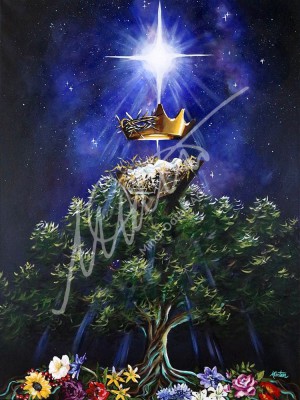
Jesus' Family Tree
Discover Jesus as: King Matthew 1 Read on Bible Gateway (HCSB)
Lesson
Audio Only
Teaching Notes
INTRO
We’ve just finished our study of the Pentateuch (Genesis, Exodus, Leviticus, Numbers, and Deuteronomy) which was written by Moses, and we’re now beginning our study of the Gospels (Matthew, Mark, Luke, and John). We’re going to keep doing that—moving from the Old Testament to the New Testament—over a two-year period. The word “gospel” literally means “good news.” Throughout the Gospels, we’re going to be talking about the good news. All of us have the bad news of sin and death, but praise the Lord, we have the good news of Jesus Christ our Lord. Remember that in the Old Testament, we gave one word for each of the books we studied, such as Seed for the book of Genesis. Through the seed of Abraham, we can see how it ultimately points to the Seed, Jesus Christ. The one word for Matthew that talks about Jesus, is King. In the book of Mark, Jesus is the Servant. In the book of Luke, the emphasis is on the Son of Man, and in John, the emphasis is on the Son of God. In Matthew, we’ll focus on Jesus as King. The word “King” is used 22 times in the book of Matthew and “kingdom” is used 32 times. The author, Matthew was one of the 12 disciples. He was also known as Levi and was a former tax collector who left everything behind to follow Yeshua. His audience was mostly Jewish Christians.
In Matthew 1, we’ll walk through Jesus’ family tree. Several things are unique to the book of Matthew: the genealogy of Jesus, Joseph’s dreams, the visitation of the wise men, the flight to Egypt, Herod’s threat to kill all the male children under two years of age, Judas’ repentance, Pilate’s wife's dream about John the Baptist, the bribery of the soldiers, and the Great Commission. Studying Matthew 1 is like studying the Pentateuch again because it provides historical records from the Old Testament.
TEACHING
Matthew 1:1-6a: Verse 1 gives the historical record of Jesus’ lineage. The genealogy itself is divided into three sections of 14 generations each for a total of 42 generations. The name of Jesus was common in the first century, and His last name was not “Christ.” It is also a common name today in the Hispanic and Latino cultures with a different pronunciation. Matthew first identified Jesus as the Son of David. Second Samuel 7:12 provides the importance of this identification: “When your time comes and you rest with your fathers, I will raise up after you your descendant, who will come from your body, and I will establish his kingdom.” When Matthew’s readers read Jesus’ genealogy, it immediately connected them to the Davidic covenant, passing through David’s son Solomon and down to Jesus.
Nelson’s commentary gave three reasons why Jesus’ genealogy was so important for Matthew: (1) it verified that Jesus was an Israelite and a Jew, (2) it identified that Jesus was connected to the tribe of Judah, and (3) it showed that He was qualified for certain religious duties.1This means that proving someone’s genealogy allowed him to walk in his calling. Genesis 12 talks about the Seed that will rule forever.
In verse 2, His lineage begins with Abraham, Isaac, Jacob, and Judah. The first 14 generations go from Abraham to David. Within Jesus’ lineage, five women are listed, including Tamar (who had sexual relations with her father-in-law), Rahab (a prostitute that protected the Israelite spies), and Ruth (a foreigner and a worshipper of idols). Tom Constable gives several reasons why the women were included: (1) to show that Jesus came for sinners, (2) to show that Jesus came for everyone, regardless of gender or race, (3) to prepare his readers for the role of Mary as a part of Jesus’ lineage, (4) to show that there were “irregular marital unions” in Jesus’ lineage, and (5) to show how God used Gentiles to show “extraordinary faith in contrast to Jews.”2The section of genealogy ends with the first mention of a king–King David (v. 6). These show that God can use anybody at any given time, regardless of the mistakes in their lives.
Matthew 1:6b-11: In verse 6b, Matthew recorded that “David fathered Solomon by Uriah’s wife.” Matthew does not name Bathsheba because he is tying her to a Hittite, he is showing us that God can also use foreigners. The second set of 14 generations go from David to the Babylonian exile when the Israelites were taken away as slaves. This section is full of people whose names are not well-known, which shows again that God can use anyone, redeem them, and use them to point to the Messiah. John 1:14 gives the significance of His coming: “The Word became flesh and took up residence among us.” Notice that Matthew didn’t include everyone in the genealogy, but that doesn’t impact the background of Jesus or His lineage.
John MacArthur, The MacArthur Bible Commentary (Nashville: Thomas Nelson, 2005), 1120.
Matthew 1:12-16: The third set of 14 generations go from the end of the Babylonian exile to the Messiah. Matthew began the genealogy in verse 1 with Jesus, and he ended it with Jesus. In verse 16, Matthew tied Jesus’ lineage to Joseph. MacArthur describes how this is important, even though Joseph was not Jesus’ biological father: “The genealogy, nonetheless, establishes His claim to the throne of David as Joseph’s legal heir.”3
Matthew 1:17: Verse 17 summarizes the breakdown of the 42 generations of Jesus. After establishing Jesus’ family lineage, Matthew moved on to give the details of Jesus’ birth. The rest of the book of Matthew is about the life of Jesus.
Matthew 1:18-25: In the first century, engagement was seen as binding as a legal marriage. In verse 18, Joseph “discovered before they came together that she (Mary) was pregnant by the Holy Spirit.” Joseph was described as a righteous man who didn’t want to disgrace Mary and was going to divorce her secretly (v. 19). However, before Joseph could do these things, an angel appeared to him (v. 20). The angel acknowledged Joseph’s lineage (son of David) and explained that God had orchestrated Mary’s pregnancy through the Holy Spirit. In verse 21, Joseph was given the name of the child, “Jesus, because He will save His people from their sins.”
CLOSING
We are the beneficiaries of the stubbornness of the Jews, of what they went through in rebellion against God, and it’s our job to minister and give back to them in any way we can.
Earl Radmacher, Ronald B. Allen, and H. Wayne House, eds. Nelson’s New Illustrated Bible Commentary(Nashville: Thomas Nelson, 1999), p. 1137.
Thomas L. Constable, Expository Notesof Dr. Thomas Constable: Matthew, 34, https://planobiblechapel.org/tcon/notes/pdf/matthew.pdf.
John MacArthur, The MacArthur Bible Commentary(Nashville: Thomas Nelson, 2005), pp. 1120.
Questions
-
How do you see God’s promise to Abraham fulfilled in Matthew 1? (Genesis 12:3; Matthew 1:1, 16)
-
Women were rarely mentioned in ancient genealogies. Who are the four Old Testament women mentioned in Matthew’s genealogy (Matthew 1:2-6)? Why do you think these particular women were mentioned? What does this tell you about God’s grace and who He chooses to use for His glory? (Genesis 38; Joshua 2:4-6; Ruth 1; 2 Samuel 11)
-
What was Matthew trying to get his readers to understand about Joseph? (Matthew 1:16)
-
What did an angel of the Lord tell Joseph about Jesus (Matthew 1:21; Acts 4:12; 13:23; Hebrews 7:25)? How did Joseph respond to this news?
-
What should have happened to Mary according to the Old Testament law of adultery (Deuteronomy 22:23-24)? Since this did not happen, what does this say about Joseph?
-
What did the Holy Spirit highlight to you in Matthew 1 through the reading or the teaching?

Daily Word
Laura Martin Matthew 1:21
She will give birth to a son, and you are to name Him Jesus, because He will save His people from their sins.
As part of God’s plan for the world, Joseph and Mary had a virgin-born son. When you hear the news that someone has had a baby, many times the first question you ask is, “What did the parents name the baby?” After an angel of the Lord appeared to Joseph in a dream, he obediently named their son, Jesus, the Greek form of the Hebrew name Joshua, which means “Yahweh saves.” Joseph and Mary may not have realized the magnitude of Jesus’ name at the time of His birth, that their newborn son was born to be the Savior of the world. He was, as the prophets foretold, Immanuel—God with us.
Think about the meaning of your own name, and pray through what it means. Ask the Lord to reveal to you how He wants to use you to impact the kingdom of God. Give thanks for Jesus, Yeshua, the great I Am, who was born to save and deliver you from your sins.
“She will give birth to a son, and you are to name Him Jesus, because He will save His people from their sins.”
— Matthew 1:21
FURTHER SCRIPTURE
- Genesis 32:28 — “‘Your name will no longer be Jacob,’ He said. ‘It will be Israel because you have struggled with God and with men and have prevailed.’”
- Luke 2:11 — “Today a Savior, who is Messiah the Lord, was born for you in the city of David.”
- 1 John 4:10 — “Love consists in this: not that we loved God, but that He loved us and sent His Son to be the propitiation for our sins.”
Lesson and Daily Word
Each day has two parts: the Lesson and the Daily Word. Use these buttons to go from one to the other.
Teaching Notes and Questions
Next to the video, these tabs show the Teaching Notes and the Questions. Your answer to a question saves when you leave the answer box.
The Bible passage
This link opens the passage on Bible Gateway, and that gives the passage its tick. If you read it in your own Bible, tick it by hand in Progress.
Your progress on this lesson
A part ticks itself when you play the video or audio to the end, read the notes or the Daily Word to the end, or answer every question. You can also tick a part by hand here.
Downloads
Here you can save the video, the audio and the lesson as PDF files. Downloads do not count toward your progress.
Need help?
Use this button to send us a question or tell us about a problem. You can also take this tour again from there.