
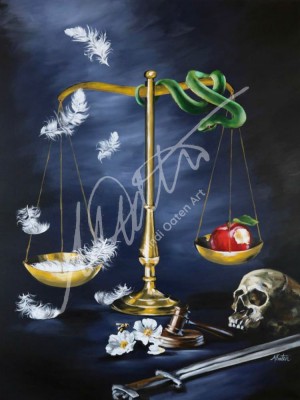
Lawlessness or Righteousness
Discover Jesus as: Judge Judges 11-12 Read on Bible Gateway (HCSB)
Lesson
Audio Only
Teaching Notes
INTRO
Jesus the Messiah is the Judge of the Old Testament and the New Testament, of the days past and the days to come. In Mindi’s painting, she shows peace through the poppy, and that the enemy wants to steal, kill, and destroy through the idolatry of the Israelites. When the Holy Spirit came on each of the judges, it tipped the scale to favor Israel. Again and again, we see the crazy era that the book of Judges took place in––an era of pendulum swings from “lawless living” to “righteous reform” and back to “lawless living.” Idolatry was rampant with gods and idols from seven different nations (Judges 10:11). Seven is a number that symbolizes completion and which shows that the Israelites had been exposed to the full wickedness of all the nations that were left in their land.
TEACHING
Judges 11:1-11: Jephthah was a great warrior, but he was the son of a prostitute (v. 1). He had a lot of baggage, because of the things of the past that he couldn’t shake off. Even his brothers turned on him (v. 2). The Israelites condemned prostitution. Prostitutes were not allowed in the house of worship, and the children of prostitutes were shunned and could not enter the house of worship. The actions of the parents followed children into their lives. Jephthah was a mighty warrior, but he carried shame from his mother’s actions. The thrust for today’s lesson, however, is that our past does not define us. The Bible states that there is no condemnation for those who are in Christ Jesus (Romans 8:1).
Jephthah fled to the land of Tob (the name means goodness) and lawless men joined him (v. 3). In other translations, these men were called scoundrels and adventurers. Jay Vernon McGee preached on Jephthah and described the process Jephthah went through in this chapter: he was exiled, exalted, and excited.1We’ve already seen Jephthah being exiled.
I don’t believe that Jephthah understood the goodness of God, and probably had preconceived notions of who Yahweh was. But when the Ammonites made war against Israel, the elders of Gilead went to Tob to get Jephthah and bring him back as their army commander (vv. 4-6). Jephthah responded in the spirit of rejection (v. 7). The elders explained they had no other options (v. 8). Jephthah agreed to go with the condition that if God gave him victory, he would be made the leader of Gilead (v. 9). They agreed, swearing God as their witness (v. 10). Jephthah went with them and repeated his terms in the presence of God before all the people (v. 11). Jephthah was finally exalted, and he was ready to be the leader God called him to be.
The name Jephthah means to open, to release. God was raising Jephthah up to open the doors of victory once again, and to bring freedom and release to the people.
Judges 11:12-22: Jephthah sent a message to the king of the Ammonites asking why they had come to fight in his land (v. 12). The Ammonites responded that Israel had taken their land (v. 13). This was a half-truth. Charles Ellicott explains, “This was a very plausible plea, but was not in accordance with facts. The Israelites was distinctly forbidden to war against the Moabites and Ammonites; but when Sihon, king of the Amorites, had refused them permission to pass peaceably through his land, and had even come out to battle against them, they had defeated him and seized his territory. It was quite true that a large district in this territory had originally belonged to Moab and Ammon, and had been wrested from them by Sihon; but that was a question with which the Israelites had nothing to do, and it was absurd to expect that they would shed their blood to win settlements for the sole purpose of restoring them to nations which regarded them with the deadliest enmity.”2(Numbers 21:21-26; Deuteronomy 2:19). Jephthah responded that the Israelites were not supposed to fight the Ammonites and he reminded them of historical events (vv. 14-22).
Judges 11:23-40: Chemosh was the national deity of the Ammonites and Moabites. His name meant the destroyer, subduer, and fish god. King Solomon would introduce the worship of Chemosh to Israel, and King Josiah years later would eradicate the practice from Israel. Jephthah questioned why the Ammonites wanted land that their god, Chemosh, had not given them and why they had waited over 300 years to try to get it back (vv. 24, 26). But the Spirit of the Lord came upon Jephthah, who traveled throughout the area into the land of the Ammonites (v. 29). Jephthah grew excited and made the vow to the
Lord that if God gave him victory over the Ammonites, he would offer whoever came out of his house first as a burnt offering to the Lord (vv. 30-31). Notice that God didn’t ask for this; Jephthah made this rash decision. God did not and does not require human sacrifice. Our God does not do that because it’s not in His nature. Jephthah was mixing religions by vowing to the God Yahweh, with the demands of the other gods in the area. After victory against the Ammonites (vv. 32-33), his daughter came out to greet him on his return (v. 34). Jephthah tore his clothes in grief as he realized his vow would take the life of his daughter, a vow he thought he could not take back (v. 35). Once again, notice Jephthah’s lack of understanding of who God is as a loving, caring, forgiving God.
Sadly, the daughter’s understanding of the Lord was no better than her father Jephthah’s, so she asked only that her father would allow her two months to wander in the mountains while she grieved her virginity before he carried out his vow (v. 37). He agreed, and at the end of two months, she returned, and Jephthah kept his vow (vv. 38-39). The young women of Israel commemorated Jephthah’s daughter for four days every year (v. 40).
What a reminder this is for us who are parents to teach our children who God really is––to paint the picture of our loving, merciful God correctly.
Judges 12:1-6: The men of the tribe of Ephraim came to Jephthah because he had not asked them to fight the Ammonites with him and threatened to burn his house down with him in it (v. 1). Ephraim wanted part of the spoils from the battle. Jephthah explained that they had been asked but had refused to go, so he had to fight without them (vv. 2-3). Sadly, Gilead and Ephraim went to war against each other, and Gilead defeated Ephraim. Forty-two thousand soldiers from Ephraim were killed in battle.
CLOSING
It is hard to know how to tie this lesson up. All the craziness, the misunderstandings of God, the cross fighting between the tribes of Israel––it’s all hard to get a handle on. One thing we can take away from this is that we need to become people who walk in freedom and release ourselves from old ways of thinking, old teachings, and old ideas of who we think God is. God is not waiting to strike people down. He is the God of love. My prayer is that we begin to see God as the Judge who focuses on the big picture, who determines what is fair, and who reigns in righteousness and justice.
Jay Vernon McGee, “07 Judges 11-15 – J Vernon McGee – Thru the Bible”; available on youtube.com.
Charles J. Ellicott, Ellicott’s Bible Commentary for English Readers: Judges 11:13; available at www.studylight.org/commentaries/ebc/judges-11.html.
Questions
-
Jephthah was chased away by his half-brothers, but when the war began, the elders called him back to help and then to rule over them. In your opinion, why did they ask Jephthah and not his brothers to help and to rule?
-
Why do you think the tribe of Ephraim refused to come and help Jephthah? Why did they become angry and threaten to kill him? (Judges 12:1-6)
-
How did the people of Ephraim try to escape? What were the results? How many lost their lives?
-
In Judges 11:27, how was the Lord referenced?
-
What did the Holy Spirit highlight to you in Judges 11—12 through the reading or the teaching?

Daily Word
Laura Martin Judges 11:1
“Jephthah the Gileadite was a great warrior, but he was the son of a prostitute, and Gilead was his father.”
Jephthah became a great warrior and leader for the Israelites. The Book of Hebrews even mentions his faith. He boldly and uniquely led the Israelites to defeat the Ammonites. Even though Jephthah was the son of a prostitute, he did not let his past define him. He honored his vow to the Lord during difficult and unlikely circumstances and led the Israelites through battle as he walked by faith.
Your past does not define you. You may have experienced abuse or come from a broken family. But praise God! Your family history does not define you. As you trust Jesus and walk with Him, remember, you are a child of God. You are a new creation—the old things have passed away and new things have come. He formed you in your mother’s womb, and He has plans for you. He will work all things together for good for those who trust in Him. Today, walk in who you are in Christ!
“Jephthah the Gileadite was a great warrior, but he was the son of a prostitute, and Gilead was his father.”
—Judges 11:1
FURTHER SCRIPTURE
- Romans 8:28 — “We know that all things work together for the good of those who love God: those who are called according to His purpose.”
- 2 Corinthians 5:17 — “Therefore, if anyone is in Christ, he is a new creation; old things have passed away, and look, new things have come.”
- Hebrews 11:32-34 — “And what more can I say? Time is too short for me to tell about Gideon, Barak, Samson, Jephthah, David, Samuel, and the prophets, who by faith conquered kingdoms, administered justice, obtained promises, shut the mouths of lions, quenched the raging of fire, escaped the edge of the sword, gained strength after being weak, became mighty in battle, and put foreign armies to flight.”
Lesson and Daily Word
Each day has two parts: the Lesson and the Daily Word. Use these buttons to go from one to the other.
Teaching Notes and Questions
Next to the video, these tabs show the Teaching Notes and the Questions. Your answer to a question saves when you leave the answer box.
The Bible passage
This link opens the passage on Bible Gateway, and that gives the passage its tick. If you read it in your own Bible, tick it by hand in Progress.
Your progress on this lesson
A part ticks itself when you play the video or audio to the end, read the notes or the Daily Word to the end, or answer every question. You can also tick a part by hand here.
Downloads
Here you can save the video, the audio and the lesson as PDF files. Downloads do not count toward your progress.
Need help?
Use this button to send us a question or tell us about a problem. You can also take this tour again from there.