
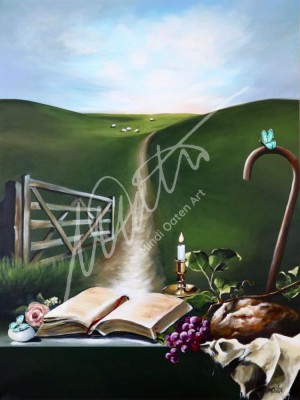
"Do You Love Me?"
Discover Jesus as: Son of God John 21 Read on Bible Gateway (HCSB)
Lesson
Audio Only
Teaching Notes
INTRO
This is the final lesson (of 89 lessons) from the Gospels. We’ve looked at the themes of King, Servant, Son of Man, and Son of God. In the Gospel of John, Jesus made seven “I am” statements that Mindi conveyed in her painting: (1) I Am the Bread of Life; (2) I Am the Light of the world; (3) I Am the Door of the sheep; (4) I Am the Good Shepherd; (5) I Am the Resurrection and the Life; (6) I Am the Way, the Truth, and the Life; and (7) I Am the True Vine. Every time Jesus said, “I am,” He was implying that He is God. In this Gospel of John, Jesus also showed seven signs or miracles. John 20:30–31 provides the reason for these signs: “that you may believe that Jesus is the Christ, the Son of God.”
TEACHING
John 21:1–3: “After this” refers to the empty tomb, the first post-resurrection appearances, the commissioning of the disciples, and Jesus’ appearance to Thomas. Jesus appeared to the disciples again at the Sea of Tiberias, also known as the Sea of Galilee. People give the disciples a hard time about retreating to Galilee, but Jesus told them three times that He would go to Galilee after His resurrection: “But after I am raised up, I will go before you to Galilee” (Matthew 26:32; Matthew 28:7; Mark 16:7). The disciples listened to what Jesus had said and went to Galilee to wait on Him. Verse 3 lists all the disciples who were fishermen: Simon Peter, Thomas the Twin, Nathanael of Cana, James and John, and two others who are unnamed. They all went fishing but caught nothing all night. Some scholars suggest the disciples were disobedient and went back to their old way of life. I believe they went to Galilee to wait for Jesus and fished while they were waiting.
John 21:4–8: At daybreak, Jesus stood on the shore, but the disciples didn’t recognize Him (v. 4), just like Mary Magdalene and the disciples on the road to Emmaus hadn’t recognized Jesus at first. Then Jesus called to them and asked them if they had any fish (v. 5). In the Greek, the words suggest that Jesus asked as if He wanted to buy fish from them. Jesus told them to cast the net on the right side of the boat to find fish. They did as He told them and caught more fish than they could pull into the boat (v. 6). This had happened before in Luke 5:1–7. Jesus used the repetition of something that had happened before to reveal Himself to them. John again referred to himself as “the disciple whom Jesus loved” and stated he had recognized Jesus (v. 7a). (John referred to himself this way five times: John 13:23; 19:26; 20:2; 21:7; and 21:20.) Do we have that burning passion and love for Jesus? Simon Peter immediately jumped into the water and swam to Jesus (v. 7b). The other disciples brought the boat and the fish, the 100 yards to shore (v. 8). We tend to think of Peter’s actions as impulsive, but possibly his running to the empty tomb and his swimming to the shore to meet Jesus is more about his recognition that Jesus is the Lord. He wanted to get back to Jesus and fix his relationship with Him after he had denied Him. It seems like those who have struggled with addiction or deep sin understand the depth of redemption more clearly than most of us. Peter wanted to get close to Jesus because he knew he had really messed up.
John 21:9–14: Jesus made them breakfast on a charcoal fire (v. 9), possibly as a picture of feeding the multitude with fish and bread. The last time Peter was at a charcoal fire, he denied Jesus three times (John 18:18, 25–27). Jesus told the disciples to bring some of the fish they caught to Him, and Peter got up and hauled the heavy net in (v. 10). There were 153 fish in the net (v. 11). John knew that because he was there as an eyewitness. (1 John 1:1–4). Jesus invited the disciples to breakfast; He was still meeting their needs (v. 12). (Matthew 6:25–33; Philippians 4:19). Wiersbe points out three times that Jesus invited people to Him: “‘Come and see’ (John 1:39); ‘Come and drink’ (John 7:37); and ‘Come and dine’ (John 21:12).”1This was the third time in the Gospel of John that Jesus appeared to His disciples (John 20:19–23; 20:26–29; and 21:7–14).
John 21:15–19: Wiersbe states that “Peter and his Lord had already met privately and no doubt taken care of Peter’s sins (Luke 24:31; 1 Corinthians 15:5), but since Peter had denied the Lord publicly, it was important there be a public restoration.”2Verses 15–19 record this public restoration. Three times Jesus asked Peter if he loved Him (John 21:15–17). Two synonyms are used for the word “love” in these verses. MacArthur explains that “when two synonyms are placed in close proximity in context, a difference in meaning, however slight, is emphasized.” 3The first time that Jesus asked the question, He used the word agape, which “signified total commitment,” while Peter responded with the word phileo, which meant brotherly love or emotional friendship.4These words are used interchangeably throughout the New Testament, so there’s not a radical difference between them. However, Jesus wanted Peter’s complete commitment as a fisher of men. He wanted to give Peter the chance to stop playing around with his commitment and to embrace it full on. Jesus responded, “Feed My lambs.” Jesus had said, “I am the Good Shepherd,” so Peter’s call was to take care of Jesus’ sheep. “The word feed conveys the idea of being devoted to the Lord’s service as an under-shepherd who cares for His flock (1 Peter 5:1–4).”5MacArthur explains that the word feed conveys giving constant nourishment to the flock, because the “primary duty of the messenger of Jesus Christ is to teach the Word of God.”6
The second time Jesus asked Peter, He told Peter to shepherd or “tend” His sheep (v. 16), and the third time Jesus asked, He told Peter to “feed” His sheep (v. 17). Jesus asked Peter three times because Peter had denied Him three times. Jesus restored Peter back completely and in front of His disciples. Peter’s denial of Jesus as the Christ bothered him so much, that he had wept bitterly.
There are people in ministry today who have really messed up, and the church tends to push them out, rather than finding a way to restore them to ministry.
As a part of his restoration, Jesus prophesied about what would happen to Peter in the future—he would die because of his faith in Jesus (vv. 18–19). Peter was martyred by the emperor Nero in AD 67–68 when he was, according to tradition, crucified upside down on a cross because he didn’t want to be crucified like his Messiah. Even though Peter messed up three times (and all of us have messed up at least once), he could be restored to ministry because of his love for Jesus.
CLOSING
What we’ve learned through Peter is that we can be restored to Christ to the point that we need to be prepared to die and suffer for Him. Any of us can have an impact for the gospel of Jesus Christ, regardless of what we’ve done in the past, because Jesus is the Son of God who has come to give us life abundantly. And that life doesn’t end because we’ve messed up. Don’t ever give up on Christ because He never gives up on us.
Warren W. Wiersbe, The Bible Exposition Commentary: Matthew–Galatians (Colorado Springs, CO: David C. Cook, 1989), p. 397.
Wiersbe, pp. 397-398.
John MacArthur, The MacArthur Bible Commentary (Nashville: Thomas Nelson Publishers, 2005), p. 1426.
MacArthur, p. 1426.
MacArthur, p. 1427.
MacArthur, p. 1427.
Questions
-
In the opening verses of chapter 21, the disciples were once again fishing with no success. Why do you think they were fishing instead of sharing the gospel of Jesus?
-
In John 21:9, when the disciples got to shore, Jesus already had fish and bread over a fire. Where did He get the fish and bread? Did Jesus “feed” them more than just food?
-
In John 21:15-17, why did Jesus ask Peter three times if he loved Him? What did Jesus mean by “feed my sheep”? Who are the sheep?
-
Why do you think Peter asked Jesus about what John was to do in John 21:21? How did Jesus respond to Peter?
-
What did the Holy Spirit highlight to you in John 21 through the reading or the teaching?

Daily Word
Laura Martin John 21:17
“He asked him the third time, “Simon, son of John, do you love Me?” Peter was grieved that He asked him the third time, “Do you love Me?” He said, “Lord, You know everything! You know that I love You.” “Feed My sheep,” Jesus said.”
FURTHER SCRIPTURE
- Lamentations 3:21–23 – “Yet I call this to mind, and therefore I have hope: Because of the Lord’s faithful love we do not perish, for His mercies never end. They are new every morning; great is Your faithfulness!
- John 18:27 – “Peter then denied it again. Immediately a rooster crowed.”
- 2 Peter 3:9 – “The Lord does not delay His promise, as some understand delay, but is patient with you, not wanting any to perish but all to come to repentance.”
Lesson and Daily Word
Each day has two parts: the Lesson and the Daily Word. Use these buttons to go from one to the other.
Teaching Notes and Questions
Next to the video, these tabs show the Teaching Notes and the Questions. Your answer to a question saves when you leave the answer box.
The Bible passage
This link opens the passage on Bible Gateway, and that gives the passage its tick. If you read it in your own Bible, tick it by hand in Progress.
Your progress on this lesson
A part ticks itself when you play the video or audio to the end, read the notes or the Daily Word to the end, or answer every question. You can also tick a part by hand here.
Downloads
Here you can save the video, the audio and the lesson as PDF files. Downloads do not count toward your progress.
Need help?
Use this button to send us a question or tell us about a problem. You can also take this tour again from there.