
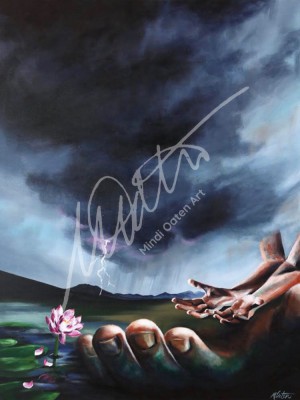
Fear Before God
Discover Jesus as: Promised Redeemer Job 37 Read on Bible Gateway (HCSB)
Lesson
Audio Only
Teaching Notes
INTRO
The book of Job is difficult to study because it is long and repetitive. Much of the book has been about the three arguments that each of Job’s three friends present to him (that’s nine arguments in all). To each argument, Job responds that he has not sinned. Although his friends could not understand, Job put his hope in the Promised Redeemer (Job 19:25-26). At the end of Job 31, Job was beginning to focus on himself and had taken his eyes off the Lord. In chapters 32—37, a new character, Elihu, enters representing God. Elihu came to be the mediator between Job and his friends. Elihu becomes a spokesman for God.
TEACHING
Job 37:1–9: Elihu speaks, stating his heart is pounding at what he has to do and pointing out God’s thunderous voice (vv. 1-3). He calls his hearers to listen to his words that come directly from the Lord. Elihu is beginning to build a case of who God is as he prepares for God to speak directly to Job and his friends. God’s voice thundered across the sky with majesty, and He takes actions mankind cannot understand (vv. 4-9). Nelson’s Commentary states, “God uses the winter storms to stop the hand of every man so that he cannot work but instead may recognize the work of God.”1 Further, Elihu’s speech “praise[d] the all-powerful God with a series of metaphors” and “describe[d] God as keeping the wind in a chamber just as He does the snow and hail.”2 For example, in verse 9, Elihu mentions the chamber in which God keeps the snow and hail stored. Isn’t that an awesome image?
Job 37:10-12: In these verses, Elihu describes the breath of God, which can form ice and freeze watery areas. God’s breath saturates the clouds and scatters lightening through the moisture-laden clouds. Nelson’s Commentary states that, in verse 12, God is portrayed “as the wise Captain who skillfully charts the course for the clouds, which respond obediently to His hand at the helm.”3
Job 37:13-17: The clouds respond to God’s direction and guidance. Nelson’s Commentary explains God causes storms to take place for three reasons: “(1) for punishment for people’s wickedness, (2) for the nourishment of the earth, and (3) for supplying the needs of His people.”4 For example, a farmer tends to be a man of prayer because the success of his crops and his very livelihood depend on how the weather treats his land. Therefore, “God uses storms both to judge the earth and to bring the blessing of rain for His people”5 (Exodus 15:7-10; Deuteronomy 28:21-24).
Job 37:18-21: “Ancient mirrors were firm and unbreakable because they were made of polished bronze.”6 Only God has the power to spread weather across the earth. Therefore, Elihu tells his listeners they should be willing to learn what they should say before God (vv. 18-20). God’s power is so much greater than ours that we cannot even look directly at the sun—something God created (v. 21). How much more difficult would it be to approach God face-to-face?
Job 37:22-24: Verse 22 states that God comes from the north. Nelson’s Commentary explains that “in ancient times, north was viewed as the direction of God’s abiding place”7 (Isaiah14:13). God would appear in gold splendor and majesty (Exodus 34). “Finally, Elihu speaks of the reverential awe and worshipful wonder that all people should have for their omnipotent Creator.”8 Therefore, because of who God is, men fear Him (v. 24) (Job 23:13-16; Psalm 19:9; 33:8; 34:11; 86:11; 111:10; Proverbs 1:7; 9:10; Ecclesiastes 12:13; Jeremiah 5:22).
CLOSING
Fear of God means to have terror, dread, respect, reverence, and honor. How do we fear God (Psalm 34:11; 86:11; Ecclesiastes 12:13)? We need to respect and reverence God by considering His creation (the power of nature at His disposal), reading His Word, and staying fast in our faith.
1 John 4:18: “There is no fear in love; instead, perfect love drives out fear, because fear involves punishment. So the one who fears has not reached perfection in love.” We don’t have to be afraid of God’s judgment or fear Him because Jesus took away our punishment when He died on the cross for us. God does not want us to cower in fear but to enjoy sweet peace in His care.
Earl Radmacher, Ronald B. Allen, and H. Wayne House, eds., Nelson’s New Illustrated Bible Commentary (Nashville: Thomas Nelson Publishers, 1999), p. 638.
Nelson’s Commentary, p. 638.
Nelson’s Commentary, p. 638.
Nelson’s Commentary, p. 638-639.
Nelson’s Commentary, p. 639.
Nelson’s Commentary, p. 639.
Nelson’s Commentary, p. 639.
Nelson’s Commentary, p. 639.
Questions
-
What did the drama of a storm remind Elihu about as far as God was concerned (Job 36:32-33; 37:1)?
-
What did Elihu say was a reason God uses winter storms? (Job 37:7)?
-
Elihu wanted Job to “stop and consider the wonderful miracles of God.” Take a few minutes and focus on that yourself. Consider all God has done for and through you.
-
In verse 24, what did Elihu finally speak on how we should regard God? (Job 28:24-28; Matthew 10:28; 11:25)
-
What did the Holy Spirit highlight to you in Job 37 through the reading or the teaching?

Daily Word
Laura Martin Job 37:24
“Therefore, men fear Him. He does not look favorable on any who are wise in heart.”
FURTHER SCRIPTURE
- Psalm 19:9 — “The fear of the Lord is pure, enduring forever; the ordinances of the Lord are reliable and altogether righteous.”
- Psalm 86:11 — “Teach me Your way, Yahweh, and I will live by Your truth. Give me an undivided mind to fear Your name.”
- Jeremiah 5:22–24 — “Do you not fear Me? This is the Lord’s declaration. Do you not tremble before Me, the One who set the sand as the boundary of the sea, an enduring barrier that it cannot cross? The waves surge, but they cannot prevail. They roar but cannot pass over it. But these people have stubborn and rebellious hearts. They have turned aside and have gone away. They have not said to themselves, ‘Let’s fear the Lord our God, who gives the rain, both early and late, in its season, who guarantees to us the fixed weeks of the harvest.’”
Lesson and Daily Word
Each day has two parts: the Lesson and the Daily Word. Use these buttons to go from one to the other.
Teaching Notes and Questions
Next to the video, these tabs show the Teaching Notes and the Questions. Your answer to a question saves when you leave the answer box.
The Bible passage
This link opens the passage on Bible Gateway, and that gives the passage its tick. If you read it in your own Bible, tick it by hand in Progress.
Your progress on this lesson
A part ticks itself when you play the video or audio to the end, read the notes or the Daily Word to the end, or answer every question. You can also tick a part by hand here.
Downloads
Here you can save the video, the audio and the lesson as PDF files. Downloads do not count toward your progress.
Need help?
Use this button to send us a question or tell us about a problem. You can also take this tour again from there.