
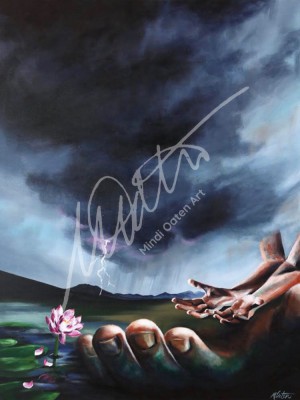
Stormy Skies
Discover Jesus as: Promised Redeemer Job 30 Read on Bible Gateway (HCSB)
Lesson
Audio Only
Teaching Notes
INTRO
Job hung on to his faith with tenacity. This chapter is about the midway point of Job’s final speech in which he expresses a lot of what he was deeply feeling. Because of this, the tone of today’s chapter is a little depressing. After Job reflected on the good things he had experienced in his past, he began this part of his speech with a key phrase: “But now” (v. 1). All of the outward calamities Job faced were starting to affect his mental state.
TEACHING
Job 30:1–15: Job reflects on his loss of honor. His position in life had changed from being a person of honor to one who sat on an ash heap. McKenna noted, “No one other than Christ Himself has experienced a greater fall from fame than Job. Symbolically, he fell from the best seat in the city gate (29:7) and the governor’s chair (29:25) to the exile of an ash heap outside the city walls (30:19). Young men who had fallen silent before him in reverence (29:8–9) were now replaced by the mocking crowd of the dregs of humanity (30:1). Instead of the aged standing in honor of him, princes falling in silence, and nobles whispering in his presence (29:8–10), Job was the object of ridicule from the rabble.”1 Job’s experience as described in chapter 30 resembles Jesus’ experience in the time between the garden (of Gethsemane) and the cross.
Job went into great detail to describe these dishonorable men who had formerly revered him but now mocked him (vv. 2–8). Formerly, Job had no use of their labor—they were unable to provide for their own needs, they scavenged for their sustenance, they were treated like thieves, they had no permanent homes, they spoke and behaved like donkeys without even having names for themselves, and they were forced to leave society. These were truly the dregs of Job’s society, and now they taunted him.
These men were now very bold in the disrespect they showed Job (vv. 9–15). They sang spiteful songs about Job. They stayed far away from him and treated him as an untouchable. They spat in his face.
Job charges God with responsibility for the way the rabble is treating him: “Because God has loosened my bowstring and oppressed me, they have cast off restraint in my presence”(v. 11). This thought was debilitating to Job. All of his strength had been taken away. Job used images of captivity and war to describe how the rabble was treating him (v. 12). Job saw terror at every turn. He saw his dignity taken from him as though by a tornado (v. 15). Even in the midst of this kind of trouble, what could be described as “the valley of the shadow of death” (Psalm 23), God was with Job. But his trouble had not yet stopped; his humiliation was not yet complete.
Job 30:16–19: Physical suffering took a toll on Job. Job knew pain in every single form. His resources were exhausted. He experienced days and nights of gnawing pain. Job claimed his clothing was “distorted with great force; He chokes me by the neck of my garment” (v. 18). Job may have been referencing his own thrashings in the night from fever, but it is clear Job ultimately held God responsible for his sufferings. Job walked the line between blasphemy and truth in these verses as he remembered the heights from which he had fallen. Job had no explanation for God’s perceived change in attitude toward him. Job knew that he had not changed, so he felt God had. Job did not know who his real adversary was.
Job 30:20–23: Job sets forth several images to describe how he felt God treated him. He felt as though God failed to acknowledge his cries and ignored him as he stood to voice his complaints (v. 20). He felt God turned against him and became his adversary (v. 21). He felt God had scattered him on the wind (v. 22). Ultimately, he felt God was leading him to his own death (v. 23).
Job 30:24–31: Job appeals to God’s compassion while expressing exactly how he feels. Job points out that even people wouldn’t condemn “a ruined man . . . because of his distress” (v. 24). How much more should God have compassion on someone like Job? Job points out he had shown compassion to those “who have fallen on hard times” and the poor (v. 25). However, everything now felt upside down: “When I hoped for good, evil came”(v. 26). His stomach was so upset he could not rest. His skin was “blackened, but not by the sun” (v. 28). He lived outside the city with wild animals (v. 29). His physical ailments continued to worsen (v. 30).
Job’s humiliation was only exceeded by Christ’s. Isaiah portrayed Christ’s sufferings this way: “He was despised and rejected by men, a man of suffering who knew what sickness was. He was like someone people turned away from; He was despised, and we didn’t value Him” (Isaiah 53:3). Job poetically summed up his reversal of fortune by noting his instruments only knew songs of lament and weeping (v. 31).
CLOSING
The wind and the ravages of life can change everything. We must hold on to the Lord in order to make it through life. Job’s sufferings foreshadowed the sufferings of Christ, but God was bigger than the sufferings of both.
“For I am persuaded that not even death or life, angels or rulers, things present or things to come, hostile powers, height or depth, or any other created thing will have the power to separate us from the love of God that is in Christ Jesus our Lord!” (Romans 8:38–39).
David L. McKenna, The Preacher’s Commentary: Job, v. 12 (Nashville: Thomas Nelson Publishers, 1986), n. pp.180, 208; available https://books.google.com/books?id=c0kc4XPPjHkC&p-g=PT1&dq=the+preacher%27s+commentary+job&hl=en&sa=X&ved=0ahUKEwjj9K7E_MTfAhVGLKwKHRBdDrQQ6AEILTAB#v=onepage&q&f=false on 1/1/19.
Questions
-
Job said, “They do not hesitate to spit in my face” (v. 10). Where else in the Bible did someone experience being spat in the face (Matthew 26:67; Mark 14:65)? What was taking place?
-
Job was clearly in great anguish over his present state. Job said, “I cry out to You for help, but You do not answer me; when I stand up, You merely look at me” (v. 20). Has there ever been a time in your life when you felt God had turned His back on you when you were in deep distress? Why does it sometimes seem like God has turned His back on us?
-
The physical pain Job experienced was extreme (vv. 16-18; 27-30). How was Job able to endure thinking God had turned His back on him?
-
What did the Holy Spirit highlight to you in Job 30 through the reading or the teaching?

Daily Word
Laura Martin Job 30:17–18
“Night pierces my bones, but my gnawing pains never rest. My clothing is distorted with great force; He chokes me by the neck of my garment.”
FURTHER SCRIPTURE
- Job 19:25–26 — “But I know my living Redeemer, and He will stand on the dust at last. Even after my skin has been destroyed, yet I will see God in my flesh.”
- Isaiah 53:3 — “He was despised and rejected by men, a man of suffering who knew what sickness was. He was like someone people turned away from; He was despised, and we didn’t value Him.”
- Romans 8:38–39 — “For I am persuaded that not even death or life, angels or rulers, things present or things to come, hostile powers, height or depth, or any other created thing will have the power to separate us from the love of God that is in Christ Jesus our Lord!”
Lesson and Daily Word
Each day has two parts: the Lesson and the Daily Word. Use these buttons to go from one to the other.
Teaching Notes and Questions
Next to the video, these tabs show the Teaching Notes and the Questions. Your answer to a question saves when you leave the answer box.
The Bible passage
This link opens the passage on Bible Gateway, and that gives the passage its tick. If you read it in your own Bible, tick it by hand in Progress.
Your progress on this lesson
A part ticks itself when you play the video or audio to the end, read the notes or the Daily Word to the end, or answer every question. You can also tick a part by hand here.
Downloads
Here you can save the video, the audio and the lesson as PDF files. Downloads do not count toward your progress.
Need help?
Use this button to send us a question or tell us about a problem. You can also take this tour again from there.