
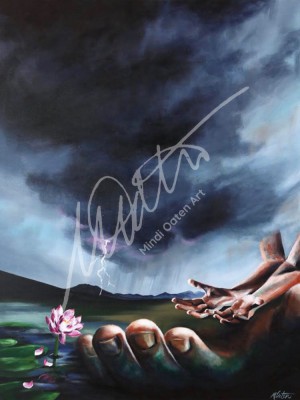
Losing Hope
Discover Jesus as: Promised Redeemer Job 14 Read on Bible Gateway (HCSB)
Lesson
Audio Only
Teaching Notes
INTRO
Yesterday, we looked at Job’s response to Zophar that turned into a prayer (Job 13). In chapter 14, Job’s conversation with God continued. Constable explains that Job’s words in chapter 14 were “really his answer to the major argument and several specific statements all three of his companions had made so far.”1
TEACHING
Job 14:1–6: Job continued discussing the brevity of life in Job 14:1 and said it was “short of days and full of trouble.” Then Job described life as a wilting flower and a fleeting shadow (v. 2). Job asked for grace (v. 3) and wondered if anyone could create something pure out of something already impure (v. 4). We are all born in a state of impurity, and we are all sinners (1 Kings 8:46; Psalm 14:1, 3; Ecclesiastes 7:20; Isaiah 64:5; Romans 3:10, 23). The blood of Christ, our mediator, is the only one who can take this on. Job next described man as a hired man whose days had already been numbered (vv. 5–6).
Job 14:7–17: Job moved from the brevity of life to the finality of death (vv. 7–17). A chopped down tree has the ability to sprout again and will not die (vv. 7–9) (Isaiah 6:13). The tree had more hope for life than Job. The “holy seed” was still within the tree stump.2This is a prophetic picture that leads to Jesus. But man had no such hope and was more like the water that evaporated completely in the soil (vv. 10–11). Job stated that when man lay down in death, there was no assurance he would live again (v. 12). However, Job asked God to hide him in death until His anger was over (v. 13). MacArthur states Job was requesting that, after God’s anger was done, he “be raised to life again when God called him back.”3Job wondered if resurrection was possible (v. 14). Job thought that if God brought him back to life, He could then count Job’s days without looking at his sin, and that God would cover his sin (vv. 15–17).
Job was asking if a person could live again. The psalmist said God would not abandon him in Sheol (Psalm 16:9–11) and that he would see God’s face when he “awoke” (Psalm17:15; Isaiah 26:19; Daniel 12:2). Job had hope that if he died, he would live again. Job 19:25–26 speaks of the Promised Redeemer that gives hope in death. God has power over the finality of death, and everyone will stand before him (Acts 24:15; Hebrews 9:27). Which side will you fall on? The side of shame or of eternal life? The New Testament also speaks of a person being able to live again. Jesus promised that Lazarus would live again (John 11:23–27). We do not have to fear the finality of death because Jesus has abolished it (2 Timothy 1:10).
Job 14:18–22: Although Job had maintained his hope in God up until this point, these last verses show a distinct absence of hope. MacArthur explains, “Job returned to his complaint before God, and reverted to a hopeless mood, speaking about death as inevitable and causing separation. He was painfully sad to think of it.”4Job described his loss of hope as a collapsed and crumbling mountain or torrents of water that wash away soil in its wake (vv. 18–19). Job told God: “You destroy a man’s hope. You completely overpower him, and he passes on; You change his appearance and send him away” (vv. 19b–20). Hope is the only thing that gets us through difficult times and friends who do not support us. Hope is the major weapon against anything we face in life (Hebrews 6:19). Our hope must be tethered to Christ Himself. Nelson’s Commentary emphasizes, “The OT believer admits that he sees little evidence for a blessed afterlife. This is the importance of Jesus’ resurrection. He promises, ‘Because I live, you will live also.’”5Belief in Christ means we are rooted in Him as our Living Hope (1 Peter 1:3). Job concluded that without hope, a man would find no honor in what happens to his own life or to the lives of others (vv. 21–22).
CLOSING
Charles Allen said, “When you say a situation or a person is hopeless, you are slamming the door in the face of God.” Our hope comes from the Lord. “Now may the God of hope fill you with all joy and peace as you believe in Him so that you may overflow with hope by the power of the Holy Spirit” (Romans 15:13).
No matter what you are going through right now, you have purpose in Christ, and you can find your hope in Him.
Thomas Constable, Dr. Constables Bible Study Notes: Job, p. 62; available at https://planobiblechapel.org/tcon/notes/pdf/job.pdf.
Earl Radmacher, Ronald B. Allen, and H. Wayne House, eds., Nelson’s New Illustrated Bible Commentary (Nashville: Thomas Nelson Publishers, 1999), p. 626.
John MacArthur, The MacArthur Bible Commentary: Job (Nashville: Thomas Nelson Publishers, 2005), p. 580.
MacArthur, p. 580.
Nelson’s Commentary, p. 627.
Questions
-
In your opinion, how could Job know God has appointed a specific number of months for each person’s life? (Job 14:5; Psalm 139:16)
-
In Job 14:12, Job spoke as though he knew there would be a resurrection. How could Job know this? What are some other examples in the Bible where the Old Testament speaks of a resurrection? (Job 19:26; Isaiah 25:8-9; 26:19; Daniel 12:2)
-
WWhat did the Holy Spirit highlight to you in Job 14 through the reading or the teaching?

Daily Word
Laura Martin Job 14:14–15
“When a man dies, will he come back to life? If so, I would wait all the days of my struggle until my relief comes. You would call, and I would answer You. You would long for the work of Your hands.”
FURTHER SCRIPTURE
- Romans 15:13 — “Now may the God of hope fill you with all joy and peace as you believe in Him so that you may overflow with hope by the power of the Holy Spirit.”
- 2 Timothy 1:10 — “This has now been made evident through the appearing of our Savior Christ Jesus, who has abolished death and has brought life and immortality to light through the gospel.”
- Hebrews 6:19 — “We have this hope as an anchor for our lives, safe and secure. It enters the inner sanctuary behind the curtain.”
Lesson and Daily Word
Each day has two parts: the Lesson and the Daily Word. Use these buttons to go from one to the other.
Teaching Notes and Questions
Next to the video, these tabs show the Teaching Notes and the Questions. Your answer to a question saves when you leave the answer box.
The Bible passage
This link opens the passage on Bible Gateway, and that gives the passage its tick. If you read it in your own Bible, tick it by hand in Progress.
Your progress on this lesson
A part ticks itself when you play the video or audio to the end, read the notes or the Daily Word to the end, or answer every question. You can also tick a part by hand here.
Downloads
Here you can save the video, the audio and the lesson as PDF files. Downloads do not count toward your progress.
Need help?
Use this button to send us a question or tell us about a problem. You can also take this tour again from there.