
The Potter's House Sermons
Discover Jesus as: New Covenant Jeremiah 18-19 Read on Bible Gateway (HCSB)
Lesson
Audio Only
Teaching Notes
INTRO
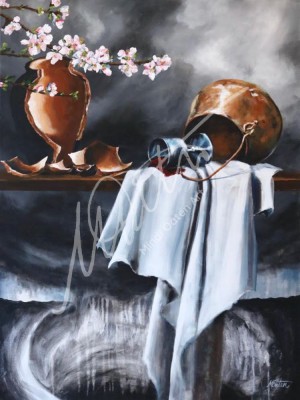
Chapters 18–19 and part of chapter 20 are different from the other chapters we studied in Jeremiah. In these chapters, Jeremiah took a “field trip” to the potter’s house. The theme of both chapters is pottery. Scholars refer to these chapters as The Potter’s House Sermons. These chapters can be broken down into three sections: A judgment parable of the potter (18:1–23); a symbolic act: the broken flask (19:1–15); and Pashhur imprisoned the prophet named Magor-missabib (20:1–6). Chapter 18 is divided into three parts as well: The parable of the potter (vv. 1–11); the people rejected by God (vv. 12–17); and the persecution of Jeremiah (vv. 18–23).
Pottery was a major economic industry in biblical times to such an extent that more than 30 Hebrew words relate to it. Possibly Jeremiah had walked past the potter’s house before. This time God gave Jeremiah a special message to share. Jeremiah would later be arrested for proclaiming the message.1 Keep in mind that “clay is not attractive in itself, but when the hands of the potter touch it, and the thought of the potter is brought to bear upon it, and the plan of the potter is worked out in it and through it, then there is a real transformation.”2 That’s what God wanted to do with the nation of Israel—mold and shape them into the masterpiece He knew they could be. He wants the same thing for us. These events probably occurred during the reign of evil King Jehoiakim, the son of King Josiah, who burned Jeremiah’s prophetic scrolls (Jeremiah 36:21–23). Jehoiakim had no love for either the Lord or His prophet.
TEACHING
Jeremiah 18:1-12: Charles E. Jefferson wrote, Jeremiah “did not get his flash of insight while he was praying but while he was watching a potter engaged in his daily work. God reveals Himself in strange places and at unexpected seasons.”3 The potter worked on two parallel stone wheels that were held together by a shaft. He turned the bottom wheel with his feet while he worked the clay on the top wheel. Wiersbe explains that Jeremiah watched how “the clay resisted the potter’s hand so that the vessel was ruined but the potter patiently kneaded the clay and made another vessel.”4 God used this image to present a message for the nation of Israel (vv. 6–10), “but the application was individual (vv. 11–17), calling for a response from the people of Judah and Jerusalem.”5
God reminded Jeremiah of His sovereign power over all the nations of the world by explaining that if He had judged a nation that repented, He would take back His judgment against it (Jonah 3). However, if God had a covenant relationship with a nation to bless it, and the nation rejected Him, He would judge the nation rather than bless it. Jeremiah was given the message to share with Judah and Jerusalem that God was going to bring harm against them, even though they would reject the warning out of stubbornness of heart (vv. 11–12). Jeremiah 17:9 shows this stubbornness, “The heart is more deceitful than anything else, and incurable––who can understand it?”
Jeremiah 18:13–17: According to Nelson’s Commentary, “the snow of Lebanon . . . describes the Mount Hermon watershed that erupts in numerous springs, providing most of the water for the Jordan River. God’s blessing was often demonstrated in the provision of water from rocks in arid regions (Exodus 17:6). No one would trade cool spring water for strange or ‘alien’ waters.”6Nelson’s Commentary goes on to explain that God was indicting Judah and Jerusalem for turning to false gods (the strange or alien waters) instead of depending upon God who provided fresh water for them from His own created universe (v. 15).7 Because of their rejection of God, the land had become a horror, and all who passed it would shake their heads in astonishment at the sight (v. 16; Jeremiah 48:27; Psalm 109:25).
Jeremiah 18:18–23: Instead of hearing God’s message and responding to it, the people became angry with Jeremiah and thought they could stop Jeremiah’s message by killing him. This was not the first time people conspired against Jeremiah (Jeremiah 11:19; 12:6; 15:15). This is another parallel to the life of Christ (Luke 23:1–5). Jeremiah could not have felt good about the opposition he felt, but he must have come to expect it8 (John 15:18; 16:33; 2 Timothy 3:12). Jeremiah turned to God to tell Him he had done what God had asked him to do, yet the people had turned away from him and God’s message (v. 19). The people even dug a pit in which to bury Jeremiah’s body (v. 20). Wiersbe points out this is the fifth time Jeremiah came before God privately to lament about how he was being treated.9
Jeremiah 19:1–9: In verses 1–3, God sent Jeremiah back to the potter’s house to purchase a clay jar. God told Jeremiah to take with him the leading priests and elders and to proclaim His message near the Potsherd Gate, where all the potters worked and left pieces of broken pottery. Wiersbe points out, “Knowing their evil plots against him, it’s an evidence of his faith that he was willing to walk with them and then do so daring a thing to declare in their very presence that disaster was coming to the land because of their sins.”10 Wiersbe emphasizes, “But Jeremiah turned the gate into a pulpit and declared impending disaster because of what the kings of Judah had done: forsaken God, worshiped idols, desecrated the temple, murdered the innocent and offered their children in altar fires dedicated to Baal”11 (vv. 3–5). According to verse 4, the people chose to worship the pagan idols that neither their parents nor the kings of Judah had known. Nelson’s Commentary explains, “The word “know” speaks of an intimate, personal knowledge that it is impossible to have with inanimate physical objects.”12 (Matthew 7:22–23; Luke 13:25–27). Verse 6 foretells that the Valley of Hinnom will be renamed the Valley of Slaughter after the Babylonian invasion.13
Jeremiah 19:10–15: God told Jeremiah to take the flask (clay jar) that he had purchased in verse 1 and to break it in front of the men who accompanied him (v. 10). Then Jeremiah was to tell the men that God was going to break the rebellious and disobedient city in the same way (vv. 11–13). Jeremiah then went to the temple and shared the same message again (vv. 14- 15).
CLOSING
Wiersbe concludes this section with these words: “Can nations and individuals sin so greatly that even God can’t restore them? Yes, they can. As long as the clay is pliable in the hands of the potter, he can make it again if it’s marred (18:4), but when the clay becomes hard, it’s too late to reform it. Judgment is the only response to willful apostasy.”14 When the people of Israel rebelled against God and refused to repent, God allowed the Assyrians to take them captive. When the people of Judah rejected God, they too faced captivity, this time under the Babylonians. Then after the Jews rejected Christ and had Him executed, 40 years later the Romans came to Jerusalem and did what the Babylonians had done centuries earlier. If you feel there are layers of hardness over your heart, ask the Lord to forgive you, form you, and shape you into the masterpiece that He sees in you (2 Corinthians 4:7).
Warren W. Wiersbe, The Bible Exposition Commentary: Old Testament (Colorado Springs: David C. Cook, 2002), p. 104.
J. Wilbur Chapman, Revival Sermons (New York: Fleming H. Revell, 1911), p. 102; quoted in Wiersbe, p. 103.
Charles E. Jefferson, Cardinal Ideas of Jeremiah (New York, Macmillan Co., 1928), p. 102; quoted in Wiersbe, p. 104.
Wiersbe, p. 104.
Wiersbe, p. 104.
Earl Radmacher, Ronald B. Allen, and H. Wayne House, eds., Nelson’s New Illustrated Bible Commentary (Nashville: Thomas Nelson Publishers, 1999), p. 906.
Nelson’s Commentary, p. 906.
Wiersbe, p. 105..
Wiersbe, p. 105.
Wiersbe, p. 106.
Wiersbe, p. 106.
Nelson’s Commentary, p. 907.
Wiersbe, p. 106.
Wiersbe, p. 106.
Questions
-
How would you explain Jeremiah 18:3–6 to someone who does not know the Bible? How does reading verse 6 make you feel? Explain why.
-
In Jeremiah 18:11, Jeremiah told of the destruction coming from the Lord if the people did not change. If a modern Jeremiah stood and gave the same message, do you think the outcome would be any different? Why or why not?
-
Do you believe that the shattered jar in Jeremiah 19 was more for Jeremiah (Jeremiah 18:3–6) or for the priests? Why?
-
What did the Holy Spirit highlight to you in Jeremiah 18—19 through the reading or the teaching?

Daily Word
Laura Martin Jeremiah 19:15
“This is what the LORD of Hosts, the God of Israel, says: ‘I am about to bring on this city—and on all its dependent villages—all the disaster that I spoke against it, for they have become obstinate, not obeying My words.’”
FURTHER SCRIPTURE
- Deuteronomy 29:29 — “The hidden things belong to the Lord our God, but the revealed things belong to us and our children forever, so that we may follow all the words of this law.”
- Jeremiah 19:10–11 — “Then you are to shatter the jar in the presence of the people traveling with you, and you are to proclaim to them: This is what the Lord of Hosts says: I will shatter these people and this city, like one shatters a potter’s jar that can never again be mended. They will bury the dead in Topheth because there is no other place for burials.”
- 1 John 2:5–6 — “But whoever keeps His word, truly in him the love of God is perfected. This is how we know we are in Him: The one who says he remains in Him should walk just as He walked.”
Lesson and Daily Word
Each day has two parts: the Lesson and the Daily Word. Use these buttons to go from one to the other.
Teaching Notes and Questions
Next to the video, these tabs show the Teaching Notes and the Questions. Your answer to a question saves when you leave the answer box.
The Bible passage
This link opens the passage on Bible Gateway, and that gives the passage its tick. If you read it in your own Bible, tick it by hand in Progress.
Your progress on this lesson
A part ticks itself when you play the video or audio to the end, read the notes or the Daily Word to the end, or answer every question. You can also tick a part by hand here.
Downloads
Here you can save the video, the audio and the lesson as PDF files. Downloads do not count toward your progress.
Need help?
Use this button to send us a question or tell us about a problem. You can also take this tour again from there.