

Waiting For The Lord
Discover Jesus as: Perfect Law James 5 Read on Bible Gateway (HCSB)
Lesson
Audio Only
Teaching Notes
INTRO
This is the last lesson in the book of James, one of the general letters. James was writing to the 12 tribes of Israel. These were Jewish Christians, the remnant from each tribe that believed in Jesus. The audience was not surrounded by a strong community of believers so they were constantly tested. MacArthur listed ten tests of James: (1) the test of perseverance in suffering; (2) the test of blame in temptation; (3) the test of response to the Word; (4) the test of impartial love; (5) the test of righteous works; (6) the test of the tongue; (7) the test of humble wisdom; (8) the test of worldly indulgence; (9) the test of dependence; and (10) the test of patient endurance.1
James was a book of tests, but the perfect law through Christ led to freedom. If believers looked to the Perfect Law, they would be blessed. In Christ, there would be every desire to walk in this way.
TEACHING
James 5:1-20: The first 11 verses of this chapter were described by MacArthur as, “The Test of Patient Endurance.”2 People who had wealth were addressed. Their wealth, possessions, and clothing were subject to deterioration such as moth and ruin. The wealth of the people would come and go before the last days.
Constable outlines ten views of money from the perspective of the world: “(1) Money brings freedom; (2) Money brings security; (3) Money is what matters; (4) Money is power; (5) Money establishes not only your net worth, but your worth as a person; (6) Money makes you successful; (7) Money gives you options; (8). Money brings happiness; (9) Money is your reward. Save it, spend it on yourself; and (10). Money is your possession. Spend on whatever you want.”3
Constable also gave ten contrasting statements of views of money from the perspective of the Word: “(1) Only Christ brings true freedom; (2) Real security is found in knowing and trusting God; (3) Christ and the kingdom of God are what matters; (4) Power comes from being filled with the Spirit; (5). Your worth is based on what God says, not what your bank statement says; (6) Success comes from knowing and doing what God says; (7) God is the One that ultimately gives you options; (8) The happiness that money brings is short lived; (9) Give as much as you can; and (10) All that you have is God’s to do with as He pleases.”4 James wanted everyone to put their stock in God.
Verse 4 addresses holding back the wages of others. Judgment would come for those who accumulated wealth at the expense of others. MacArthur states, “Like fattened cattle ready to be slaughtered, the rich that James condemns had indulged themselves to the limit.”5 Overindulgence had crept into the lives of those James addressed in this letter.
The rich were hording their funds and withholding wages. In verse 6 James stated they were controlling the courts with their money. The rich had indulged themselves to the limits.
The instruction to the believers was to be patient until the Lord comes. MacArthur explains: “Realizing the glory that awaits them at Christ’s return should motivate believers to patiently endure mistreatment (Romans 8:18).” He then explained the phrase, “the early rain and latter rain,” stating, “The rain falls in Israel during October and November and softens the ground for planting. The latter rain falls in March and April, immediately before the spring harvest. Just as the farmer waits patiently from the early rain to the latter for his crop to ripen, so must Christians patiently waif for the Lord’s return (cf. Galatians 6:9; 2 Timothy 4:8; Titus 2:13).”6 Christ had come and now they would have to wait patiently for the great harvest. In the waiting, the believers should not put their faith in their finances.
The body of Christ was expected to patiently endure. But even when they planted, they needed to wait and strengthen their hearts. The Lord’s coming was near. They should not complain or grumble. The judge was standing at the door of the courtroom.
James was like a mini-Proverbs. The prophets were mentioned in verse 11, and Job was referred to as an example of patient endurance.
Verse 12 addressed the test of truthfulness. What the believers said, they were not to take lightly, so they would not fall under judgment.
In verse 13 James shifted to the test of prayerfulness. For those who were suffering, others should pray for them. If anyone was sick, they were “to call the elders of the church for strength, support, and prayer.”7 The prayer of faith would save, restore, and heal the sick person. The person would also be forgiven of their sin. Elijah was referred to as the example of the power of prayer.
Verse 19 was about the test of true faith. Christ wanted to give the believers full freedom. Those who turned a sinner back from the error of his ways would save their life and cover a multitude of sins. They would save a soul from death (v.20).
CLOSING
Jesus, as the Perfect Law, wants to give us full freedom. When a sinner was away from the Lord and came back, it was significant. Christ wanted to give freedom from the bondage of sin. Prayer was required to walk this out to a point of experiencing the full freedom.
John MacArthur, The MacArthur Bible Commentary (Nashville: Thomas Nelson Publishers, 2005), pp. 1881–1895.
MacArthur, p. 195.
Thomas Constable, Constable’s Expository Bible Study Notes: James, pp. 93–94; available at https://planobiblechapel.org/tcon/notes/pdf/james.pdf.
Constable, pp. 93-94.
MacArthur, pp. 1895–1896.
MacArthur, p. 1896.
MacArthur, p. 1897.
Questions
-
In James 5:2, what was the message James was trying to get across (Matthew 6:19–21)? Where is your treasure stored?
-
Have you ever found yourself complaining about someone as in James 5:9? Has the Lord rebuked you for it or shown you that only He is the judge? If so, in what ways?
-
Where in Scripture are we told to have patience and that we will suffer but to count our blessings as in James 5:10–11 (John 16:33)? Have you experienced suffering? If so, do you take comfort in those verses? Why or why not?
-
In James 5:15, James said that a prayer in faith will save and the Lord will restore. Have you been prayed for and experienced healing? If so, what happened?
-
Have you ever laid hands on someone and prayed a prayer of faith and seen them healed? If not, would you be bold enough in your faith to pray for healing for someone today?
-
What did the Holy Spirit highlight to you in James 5 through the reading or the teaching?
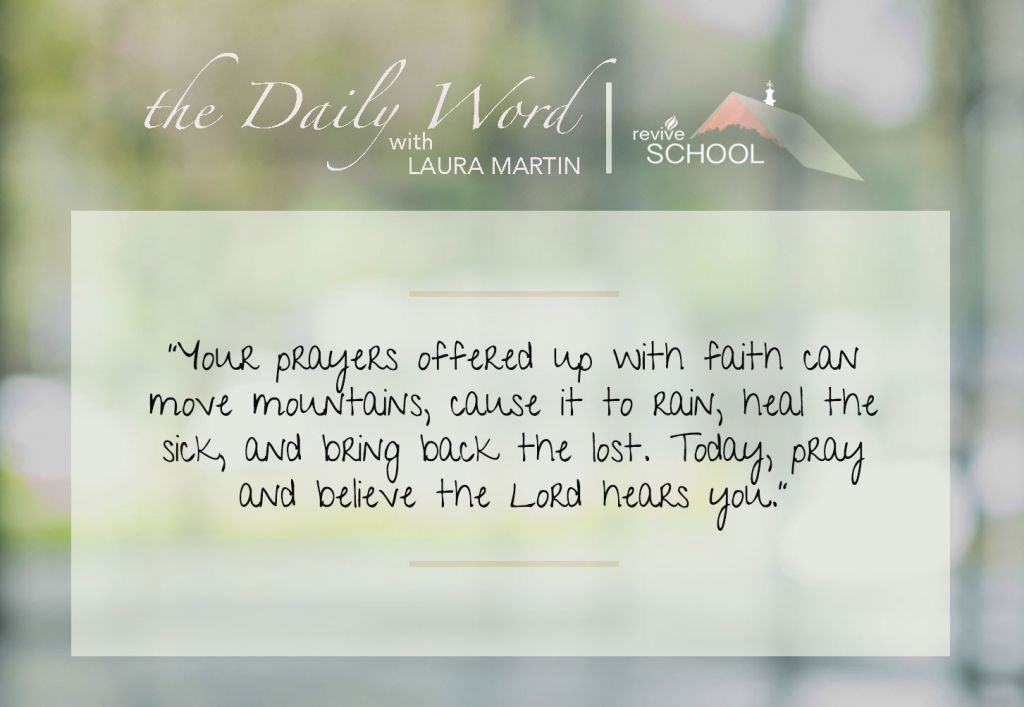
Daily Word
Laura Martin James 5:17b–18
“The urgent request of a righteous person is very powerful in its effect. Elijah was a man with a nature like ours; yet he prayed earnestly that it would not rain, and for three years and six months it did not rain on the land. Then he prayed again, and the sky gave rain and the land produced its fruit.”
FURTHER SCRIPTURE
- 1 Kings 18:41–42 — “Then Elijah said to Ahab, ‘Go up, eat and drink, for there is the sound of a rainstorm.’ So Ahab went to eat and drink, but Elijah went up to the summit of Carme. He bowed down on the ground and put his face between his knees.”
- Romans 10:9–10 — “If you confess with your mouth, ‘Jesus is Lord,’ and believe in your heart that God raised Him from the dead, you will be saved. One believes with the heart, resulting in righteousness, and one confesses with the mouth, resulting in salvation.”
- 1 John 5:14 — “Now this is the confidence we have before Him: Whenever we ask anything according to His will, He hears us.”
Lesson and Daily Word
Each day has two parts: the Lesson and the Daily Word. Use these buttons to go from one to the other.
Teaching Notes and Questions
Next to the video, these tabs show the Teaching Notes and the Questions. Your answer to a question saves when you leave the answer box.
The Bible passage
This link opens the passage on Bible Gateway, and that gives the passage its tick. If you read it in your own Bible, tick it by hand in Progress.
Your progress on this lesson
A part ticks itself when you play the video or audio to the end, read the notes or the Daily Word to the end, or answer every question. You can also tick a part by hand here.
Downloads
Here you can save the video, the audio and the lesson as PDF files. Downloads do not count toward your progress.
Need help?
Use this button to send us a question or tell us about a problem. You can also take this tour again from there.