

Controlling The Tongue
Discover Jesus as: Perfect Law James 3 Read on Bible Gateway (HCSB)
Lesson
Audio Only
Teaching Notes
INTRO
The author of James was most probably the half-brother of Jesus. James wrote to the believers who had been dispersed around the known world due to the persecution that began in Jerusalem and then spread out into other areas.
In James 3 the author gave six metaphors for the tongue and about how our tongues impact those around us. Wiersbe points out that James described what it takes to be a mature Christian: “He is patient in trouble (James 1) and he practices the truth (James 2). In this section [chapter 3] . . . he has power over his tongue.”1
TEACHING
James 3:1-8: Hebrews 5:11–14 states that all believers should be teaching. However, James wrote that not many should become teachers because they will be held under stricter judgment (v. 1) if they communicate God’s truth but do not live it out in their lives (v. 2; 1 John 2:20, 27). MacArthur states that this stricter judgment “refers to a future judgment: (1) for the unbelieving false teacher, at the Second Coming (Jude 14,15); and (2) for the believer, when he is rewarded before Christ (1 Corinthians 4:3–5).”2 This stricter judgment is not meant to discourage those who are called to teach but rather to warn potential teachers of the significance of the call.3 MacArthur defines the word stumble as “sinning or offending God’s person.”4
James emphasized that those teachers who were hypocritical in their teachings and lives—teaching one thing but doing another—would be held in judgment. The requirement is to keep the entire body under control (v. 2b). Scripture contains much about the evil the tongue can cause (Psalm 5:9; 34:13; 39:1; 52:4; Proverbs 26:28; 28:23). MacArthur states, “The tongue has immense power to speak sinfully, erroneously, and inappropriately.”5
Wiersbe explains that the tongue has the “Power to Direct.”6 Verses 3–5 give illustrations: the bit in the mouth of a horse guides the whole animal (v. 3); the small rudder guides a large ship, even against fierce winds (v. 4); and a small fire can spread across an entire forest (v. 5). The tongue is also a small thing that has the “Power to Destroy.”7
Wiersbe used the example of the Great Chicago Fire in 1871. A fire that started in the O’Leary barn spread across Chicago, leaving 100,000 people homeless, 17,500 buildings destroyed, 300 people dead, and over $400,000,000 in damages.8 The tongue is also a fire and can pollute the whole body. It also “is set on fire by hell” (v. 6) (Proverbs 26:20–21). MacArthur explains the word hell is from the Greek word Gehenna (the valley of Hinnom). “In Christ’s time, this valley that lay southwest of Jerusalem’s walls served as the city dump and was known for its constantly burning fire. Jesus used that place to symbolize the eternal place of punishment and torment (Mark 9:43, 45).”9 This means that if your tongue controls your body, the evil of your tongue will send you on a different path from what God had planned for you. This also suggests that without control of the tongue, we have given control over to the enemy. This leads into the next illustration—man has learned to control every creature on the planet except for his own tongue, which is evil and full of poison (vv. 7–8).
James 3:9–12: Wiersbe states the tongue has the “Power to Delight.”10 We praise the Lord with our tongues, and then curse people who are made in God’s likeness (v. 9); praising and cursing comes out of the same mouth (v. 10). James used the image of a spring that can only give one kind of water, either sweet or bitter, but not both (v. 11). He also used the picture of how a fig tree can only produce figs and is incapable of producing olives (v. 12). This ties back to James 2—what we believe is what should be seen and heard from us.
Think of how we could impact others by having one goal each day—to speak Christ and life into others.
James 3:13–26: James moved on to having wisdom on a daily basis (v. 13). How bitter envy and selfish ambition is earthly, unspiritual, and demonic (vv. 14–15), “But the wisdom from above is first pure, then peace-loving, gentle, compliant, full of mercy and good fruits” (vv. 16–17). All of it comes from Him—the fruit of righteousness—and we become the carriers of peace (v. 18).
CLOSING
When we have faith in Him, we will walk it out. We will look like Him and walk like Him.
Warren W. Wiersbe, The Exposition Bible Commentary (Colorado Springs: David C. Cook, 1989), p. 357.
John MacArthur, The MacArthur Bible Commentary (Nashville: Thomas Nelson Publishers, 2005), p. 1889.
MacArthur, p. 1889.
MacArthur, p. 1889.
MacArthur, p. 1889.
Wiersbe, p. 358.
Wiersbe, p. 359.
Wiersbe, p. 339.
MacArthur, p. 1889.
Wiersbe, p. 360.
Questions
-
James 3 has a lot to say about bridling the tongue. Why is it so important to tame our tongue? (Psalm 141:3; Matthew 12:36– 37; Romans 3:13–14; James 1:26; 3:1–12)
-
How does James 3:1 tie in with taming the tongue? Why do you think teachers will be judged more strictly?
-
James 3:8 says no one can tame the tongue. How are we to bridle or tame our tongues if no man is able to?
-
James 3:9–12 discusses how the same tongue blesses God and curses men who are made in His likeness. The next verses contrast the wisdom that comes from above with earthly wisdom. How do the verses on wisdom relate to the former verses on blessing and cursing?
-
Wisdom is a theme that surfaces multiple times throughout James. How does James 1:5–8 say we acquire wisdom? How is the wisdom that comes from above described in James 3:17? How do bitter jealousy (envy) and selfish ambition affect us, and where is that “wisdom” derived from?
-
What did the Holy Spirit highlight to you in James 3 through the reading or the teaching?
Daily Word
Laura Martin James 3:5–6a
“So too, though the tongue is a small part of the body, it boasts great things. Consider how large a forest a small fire ignites. And the tongue is a fire.”
Ask yourself these questions: Do the words leaving my mouth edify others? Am I producing healing words or demeaning words? James describes the tongue as a small part of the body, and yet it boasts great things. The tongue has the power and ability for great impact, positive or negative, in just a moment, like a rudder affects a boat. Even the smallest words can make a positive impact or create havoc, like a small fire igniting an entire forest. Just as a small bit controls the course of a horse on a path, your tongue controls the path of your life.
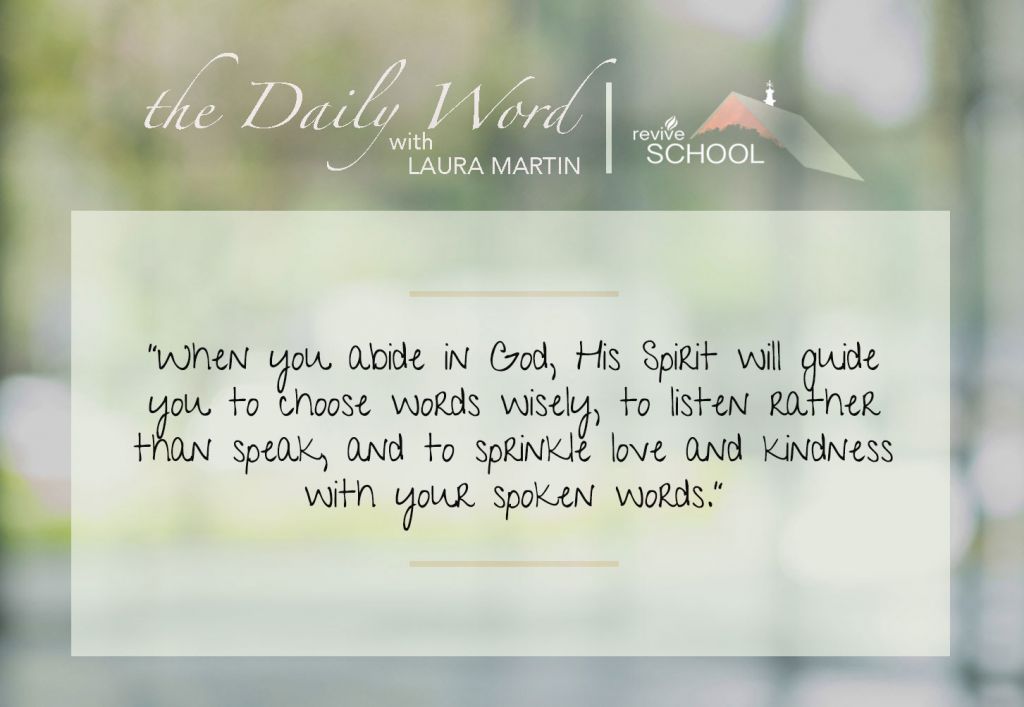
It may seem like an overwhelming responsibility to control your tongue. Ask the Lord for help. He will empower you with grace and power as you abide in Him, rest in Him, and walk with Him. The more time you spend in His Word, soaking His truth into your heart, the more He will empower you with self-control over your tongue. You will walk in His Spirit and not in your flesh. When you abide in God, His Spirit will guide you to choose words wisely, to listen rather than speak, and to sprinkle love and kindness with your spoken words. Today, ask the Lord to help you control your tongue. With Jesus, all things are possible.
“So too, though the tongue is a small part of the body, it boasts great things. Consider how large a forest a small fire ignites. And the tongue is a fire.”
— James 3:5–6a
FURTHER SCRIPTURE
- John 15:5 — “I am the vine; you are the branches. The one who remains in Me and I in him produces much fruit, because you can do nothing without Me.”
- Ephesians 4:29 — “No foul language is to come from your mouth, but only what is good for building up someone in need, so that it gives grace to those who hear.”
- James 1:19 — “My dearly loved brothers, understand this: Everyone must be quick to hear, slow to speak, and slow to anger.”
Lesson and Daily Word
Each day has two parts: the Lesson and the Daily Word. Use these buttons to go from one to the other.
Teaching Notes and Questions
Next to the video, these tabs show the Teaching Notes and the Questions. Your answer to a question saves when you leave the answer box.
The Bible passage
This link opens the passage on Bible Gateway, and that gives the passage its tick. If you read it in your own Bible, tick it by hand in Progress.
Your progress on this lesson
A part ticks itself when you play the video or audio to the end, read the notes or the Daily Word to the end, or answer every question. You can also tick a part by hand here.
Downloads
Here you can save the video, the audio and the lesson as PDF files. Downloads do not count toward your progress.
Need help?
Use this button to send us a question or tell us about a problem. You can also take this tour again from there.