

Zion's Restoration
Discover Jesus as: Immanuel Isaiah 62-64 Read on Bible Gateway (HCSB)
Lesson
Audio Only
Teaching Notes
INTRO
It seems that in Isaiah 60, Isaiah was talking about many things that would come to fruition. He talked about the aftermath—things were going to look good in Zion because they would see progression and hope. Then in chapter 61 Isaiah identified who would help with that. Tom Constable points out that in Isaiah 62, when Israel leaves Babylonian exile, the people could be assured God would fulfill all the things He had promised.1 Isaiah 62 is a confirmation that God will do this.
TEACHING
Isaiah 62:1-5: God is speaking in these verses. God’s goal for Zion/Jerusalem was that her righteousness would shine brightly (v. 1) so that other nations would know God’s hand was upon her (v. 2). Remember that Isaiah 13—23 pronounces oracles of judgment against nations. Now God wanted to be sure these nations saw what was happening in Zion. Jerusalem would have a new name (v. 2b) that reflected Israel’s status. Zion had been called Deserted and Desolate (v. 4) because Babylon conquered them in 586 BC. One new name is “My Delight is in Her,” and another is “Married.” This is a cool picture. Isaiah 61:10 describes the new clothing God will give to Zion as “garments of salvation” and “a robe of righteousness.” In Genesis 17:5, Abram’s name was changed to Abraham, and he went from Abram the father of none to Abraham the father of a great nation. In Genesis 32:28, Jacob’s name was changed to Israel. Now Israel’s name would be changed from Deserted and Desolate to Delighted in Her and Married. Verse 12 adds the names Holy People, the Lord’s Redeemed, Cared For, and A City Not Deserted.
God’s hand will be upon Israel because He delights in her (v. 4). The imagery of married doesn’t imply that there was ever a divorce. But it does imply God and the nation are reconciled and have become one. Israel will become “a glorious crown” in God’s hand (v. 3). Israel will not receive a crown of glory but they are a glorious crown. Jerusalem will no longer be deserted—a word that implies forsaken—but now God will rejoice over them (v. 5). Though they felt deserted and forsaken, God had never forsaken them. Hebrews 13:5b is a picture of Isaiah 62 because it summarizes that God has not forgotten about His people. Instead, God totally loves them—and He totally loves us.
Isaiah 62:6-9: Up until this point, the stereotype of the watchman in Israel has been someone who was not watching the sheep. But now God tells them He has given them even more watchmen and prophets who will continually proclaim who God is (v 6). All of the victories by foreigners, the wicked, and even the animals, is now done. All that domination, taking over Jerusalem, is done (v. 8). Instead, they will get to eat the grain and drink the wine from the grapes they harvest (v. 9). John MacArthur labels the temple in the phrase “My holy courts” as the millennium temple.2
Up until this point, God’s goal had been for all the nations to see God at work in Jerusalem. In this progression, we saw the Gentiles worship the Lord in Isaiah 56. Both Jews and Gentiles will have the opportunity to worship in the temple or from the courts around the temple. At the time Isaiah wrote this, Solomon’s temple was still standing. That temple was destroyed by the Babylonians in 586 BC when the Israelites were taken into captivity. So, when will people actually drink wine in God’s holy courts? We know that King Cyrus released the Israelites in 539 BC to return to Jerusalem and rebuild the temple. Isaiah could have been talking about the time when the second temple existed. This temple, sometimes called Zerubbabel’s temple, was destroyed by the Romans in AD 70. As of right now, there is no temple in Jerusalem. Jesus prophesied the destruction of the Jerusalem temple in Matthew 24:1-2. In Matthew 24:15, Jesus warned, “So when you see the abomination that causes desolation, spoken of by the prophet Daniel, standing in the holy place (let the reader understand).” This referred to the time when the antichrist would stand in the holy place—meaning the third temple that does not exist right now. So, we know there will be a third temple. Revelation 11:1-2 talks about the third temple, which will exist at some point in time. There are politicians in Israel today who are calling for the building of the third temple. The Temple Institute has items and utensils that are ready to be placed into the third temple. The Sanhedrin has been reinstituted in Israel, and one of its purposes is to rebuild the temple. Why should Christians care about this? First, it’s in Revelation. Second, Christ is coming back. Third, we have a part in worshiping there. So, this little phrase, “in My holy courts,” is a picture of the end, and people will worship together at the holy temple.
Isaiah 62:10-12: Practically speaking, the third temple needs to be built in Jerusalem. Most people say the temple needs to be placed where either the Dome of the Rock or the Al-Aqsa Mosque are presently located. Verse 10 makes me think of getting Israel and the nations ready for Christ’s return. Whether the highway is literal or figurative, our goal is to prepare the highway for Jesus’ second coming. According to Nelson’s Commentary, “Prepare the way means to encourage the people to come to the temple for worship . . . Lift up a banner is an encouragement to all peoples to worship God.”3
In verse 11, the Hebrew word for say is actually plural. According to Nelson’s Commentary, because it’s plural, it indicates, “A number of people will declare this announcement of salvation to Jerusalem.”4 Eventually there will be multiple people saying Jesus is the way. These people are the remnant, and they will declare Jesus’ coming. Compare this verse with the message in Matthew 21:9, when the people in Jerusalem began shouting, “Hosanna to the Son of David!” But Jesus didn’t look like the Messiah they were expecting, so they didn’t accept Him as Lord and Savior. Zechariah 9:9 pictures the salvation of Jerusalem as a righteous king riding on a donkey. If this verse speaks of the first coming, since the Jews rejected Jesus, they now need a second chance. So, yes, Isaiah spoke of the first coming and the second coming. Hopefully there is still a remnant inviting people to worship Him.
CLOSING
When you embrace the salvation that is coming, then you can understand that you have been redeemed and that you are walking in holiness. It’s a hard thing to hold up the banner inviting people to worship Christ when they respond by saying, “Not yet.”
The Book of Isaiah spoke to those who were going to be in exile and then set free. In exile they would need to look for the first time that Jesus came. When that happened, not all of them embraced Him (John 1:10). Now we have to wait for the second coming for the people to embrace Jesus. When that happens, we will have a huge worship celebration as the Jews and Gentiles come together because their focus is on the Anointed One, Immanuel, God with Us.
Thomas Constable, “Dr. Constable’s Notes on Isaiah,” p. 432; available from http://planobiblechapel.org/tcon/notes/pdf/isaiah.pdf.
John F. MacArthur, The MacArthur Bible Commentary (Nashville: Thomas Nelson Publishers, 2005), p. 838.
Earl Radmacher, Ronald B. Allen, and H. Wayne House, eds., Nelson’s New Illustrated Bible Commentary (Nashville: Thomas Nelson Publishers, 1999), p. 871.
Nelson’s Commentary, p. 871.
Questions
-
Isaiah 62:1-2 talk about the righteousness of Zion and Jerusalem, yet Psalm 14:1, 3 says, “There is no one who does good.” How can anyone be seen as righteous? (Isaiah 61:10-11; Philippians 1:11; 3:9)
-
In Isaiah 62:4, to whom did Isaiah deliver this message? Who else might it be delivered to?
-
Isaiah has a conversation with someone in Isaiah 63:1-3 whom he asked why His garments were red. What was the response? Read Revelation 19:13, 15. Do you believe this is the same person who spoke in Isaiah 63:3?
-
Isaiah 63:9 informs us, “In all [Israel’s] suffering, He suffered.” Meditate on what this verse tells us about the Lord. Does this truth at all change how you see Him?
-
Isaiah 64:6 says all our righteous acts are like a filthy or polluted garment. Why then do you think we keep trying to “clean up our act” or do things on our own?
-
What did the Holy Spirit highlight to you in Isaiah 62—64 through the reading or the teaching?
Daily Word
Laura Martin Isaiah 62:1–2
“I will not keep silent because of Zion, and I will not keep still because of Jerusalem, until her righteousness shines like a bright light and her salvation, like a flaming torch. Nations will see your righteousness and all kings, your glory. You will be called by a new name that the LORD’s mouth will announce.”
Have you ever had some crazy fun news you just couldn’t keep quiet? Maybe someone’s expecting a baby or the Lord healed a friend or provided in a miraculous way? Isaiah announced he would not keep silent about all the Lord did for Jerusalem. The righteousness of God shone like a bright light—like a flaming torch. Picture the Olympic torch. You can’t hide that kind of bright light!
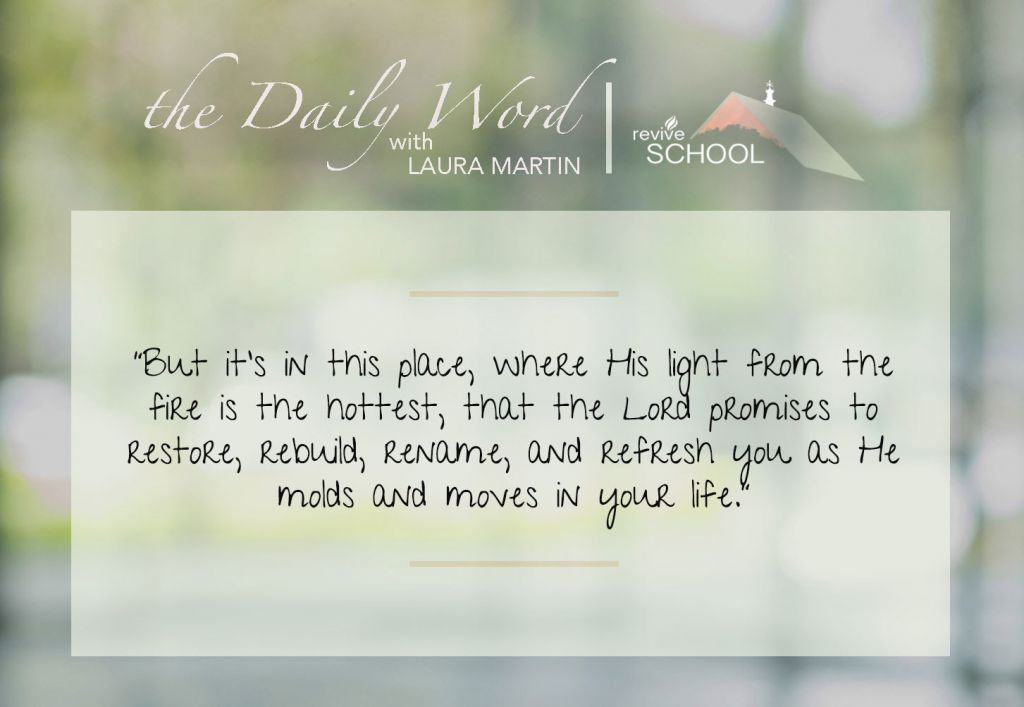
As the Lord moves in your life, His light will shine brightly in you— like a big, flaming torch. Yes, it may take some molding, some walking through the fire, or even having your life reduced to ashes and broken- ness. But it’s in this place, where His light from the fire is the hottest, that the Lord promises to restore, rebuild, rename, and refresh you as He molds and moves in your life. His light will shine brightly for all to see His great love and righteousness. Proclaim His goodness to all! Shine your light. God has given you a new name, a new heart, a new righteousness, and a new love. The Lord delights in you. He rejoices over you. Today, don’t stay silent!
“I will not keep silent because of Zion, and I will not keep still because of Jerusalem, until her righteousness shines like a bright light and her salvation, like a flaming torch. Nations will see your righteousness and all kings, your glory. You will be called by a new name that the Lord’s mouth will announce.”
— Isaiah 62:1–2
FURTHER SCRIPTURE
- Isaiah 63:7–8 — “I will make known the Lord’s faithful love and the Lord’s praiseworthy acts, because of all the Lord has done for us—even the many good things He has done for the house of Israel and has done for them based on His compassion and the abundance of His faithful love. He said, ‘They are indeed My people, children who will not be disloyal,’ and He became their Savior.”
- Isaiah 64:8 — “Yet Lord, You are our Father; we are the clay, and You are our potter; we all are the work of Your hands.”
- Matthew 5:15–16 — “No one lights a lamp and puts it under a basket, but rather on a lampstand, and it gives light for all who are in the house. In the same way, let your light shine before men, so that they may see your good works and give glory to your Father in heaven.”
Lesson and Daily Word
Each day has two parts: the Lesson and the Daily Word. Use these buttons to go from one to the other.
Teaching Notes and Questions
Next to the video, these tabs show the Teaching Notes and the Questions. Your answer to a question saves when you leave the answer box.
The Bible passage
This link opens the passage on Bible Gateway, and that gives the passage its tick. If you read it in your own Bible, tick it by hand in Progress.
Your progress on this lesson
A part ticks itself when you play the video or audio to the end, read the notes or the Daily Word to the end, or answer every question. You can also tick a part by hand here.
Downloads
Here you can save the video, the audio and the lesson as PDF files. Downloads do not count toward your progress.
Need help?
Use this button to send us a question or tell us about a problem. You can also take this tour again from there.