

The Second Servant's Song
Discover Jesus as: Immanuel Isaiah 47-49 Read on Bible Gateway (HCSB)
Lesson
Audio Only
Teaching Notes
INTRO
We’re headed to the study of Isaiah 49. But there’s so much to get into before we get to that chapter. We’re still in the second half of Isaiah, or the ”book of comfort” (Isaiah 40—66). In chapter 47, Isaiah tells his hearers that God called Babylon to lament because they trusted in magic and astrology. Then, in chapter 48, God gives the people their marching orders to leave Babylon. In verse 12 of chapter 48, God gives His name, “I am He; I am the first, I am also the last,” connecting both the Old Testament and the New Testament.
We heard in our study of Isaiah 45 that Cyrus was anointed. In verses 14-15 of Isaiah 48, God announces He loves Cyrus, the Persian king, and would use Cyrus to fulfill His divine purpose. The only other king in the Old Testament who was described as being loved by God was Solomon, a Jew. Cyrus was a Persian (a Gentile), and for him to be loved by God was somewhat shocking. Interestingly, God’s use of Cyrus was not aimed at Israel but at Babylon. Note that Isaiah’s prophecy of Cyrus was written 200 years before Cyrus became king. Cyrus would one day conquer Babylon and send the Jewish remnant back to the land of Israel. Cyrus would even pay for the rebuilding of the temple in Jerusalem. God had a plan, which included a Persian king. God had intended all along to bless Israel, but Israel would not cooperate. So, Isaiah prophesied that Israel would have one more chance to receive God’s blessing.
This leads us to Isaiah 49. We talked in our study of Isaiah 42 of the four “servant songs” of Isaiah that describe the service, suffering, and exaltation of the servant of the Lord––the Messiah. In chapter 49, we’ll look at the second servant song in verses 1-13.
TEACHING
Isaiah 49:1-7: The second servant song speaks of the Messiah’s work in the world and His success. Alan Redpath said, “This chapter is full of our Lord Jesus Christ, and the words quoted could not possibly have their complete fulfillment in any other save in our Savior.”1 In verse 1, Isaiah states that the servant had been called by the Lord while he was still in his mother’s womb (Jeremiah 1:5; Micah 5:2). In verse 2, the servant describes how God had strengthened and used his mouth like a sharp sword. Ephesians 6:17; Hebrews 4:12; Revelation 1:16; 2:12,16; 19:15 also describe the prophetic use of a sword.
In verse 3, the statement, “You are My Servant, Israel,” is best understood to regard Israel as a reference to the Messiah. This is important because, first, the Messiah comes from Israel and is a representative of the nation, and second, the Messiah fulfills the name Israel, which means, “governed by God.”2 Verse 4 goes on to describe the suffering and great loss the Servant felt. Isaiah was able to see the discouragement Jesus felt during the temptation, the discouragement He felt when the disciples messed up or misunderstood His teaching, and the discouragement He felt in the garden of Gethsemane when those closest to Him let Him down. Isaiah shows that even though the Messiah ministered in difficult and discouraging circumstances, He never gave into discouragement. He always put His trust in the Lord. He would even be honored in God’s eyes.
Verse 5 shows that an important aspect of the Messiah’s mission was to bring Israel back to the Lord. Israel has an enduring place in God’s plan, and His plan will be fulfilled. Romans 11:26 says: “And in this way all Israel will be saved, as it is written: The Liberator will come from Zion; He will turn away godlessness from Jacob.” The Messiah would restore God’s people and is chosen to redeem the Gentiles (v. 6). Simeon saw the child Jesus as “a light for revelation to the Gentiles and glory to Your people Israel” (Luke 2:32). Did Simeon understand that the prophecy of Isaiah was in his hands? The Messiah would not simply bring salvation, but He would be His salvation to the end of the earth (v. 6b).
Verse 7 describes the acclaim the Messiah would receive worldwide, even after having been despised by the people. Surely no one who heard this message from Isaiah would have believed the Messiah would one day be despised and rejected. And yet it happened.
Isaiah 49:8-13: The servant of the Lord would oversee the restoration of the land and the establishing of a peaceful kingdom (vv. 8-13). The Messiah would be the covenant for the people and restore the land of Israel (v. 8b). The Messiah’s ministry would set people free from bondage and imprisonment (vv. 9-10). In an immediate sense, this refers to God’s supply and sustaining of the exiles returning from Babylon to Judah, through the unseen hand of the Messiah. In a larger sense, it speaks of the mercy and provision of God for people as they return to Him in the last day.
Verse 11 states that God would make all His mountains into highways. All means ALL. That means there is nothing in life— no obstacle, no loneliness, no trial, no sorrow—that may not be a way into God’s richest blessings. “My mountains” means that those in the way are still the Lord’s mountains and allowed to be there for a purpose. Christ is there in the midst of the mountains—in the midst of the trials.
God promised to bring His people back from the far reaches of the world (v. 12). Sinim could possibly be a place around Aswan in Egypt or maybe in China. One commentary theorized that Isaiah was being intentionally unclear, using a made-up place, to show that God would bring the captives back from every conceivable place on earth. The Messiah will be the agent of the Lord’s comfort and salvation to His people (v. 13).
Note that on their first missionary journey, Paul and Barnabas brought the gospel to the Gentiles in Antioch and they quoted Isaiah 49:6: “I have made you a light for the Gentiles to bring salvation to the ends of the earth” (Acts 13:47). The response of the Gentiles in Antioch was pure joy: “When the Gentiles heard this, they rejoiced and glorified the message of the Lord, and all who had been appointed to eternal life believed. So the message of the Lord spread through the whole region” (Acts 13:48-49). Ephesians 2:11-18 explains how the Jews and the Gentiles are made one.
Isaiah 49:14-26: Zion refers to the highest hill in Jerusalem and the place of God’s people by association. In verse 14, Zion objected to what was happening, and believed that God had forsaken it. The rest of chapter 49 will answer the question, “Does God really care about us?” God does care, and the Lord proclaimed His love and faithfulness to Zion. Verse 16 describes the Messiah’s hands after the resurrection (John 20:27).
CLOSING
When we see the nail-scarred hands of Jesus, we see how He has inscribed us on the palms of His hands. With such love, how could God ever forget His people.
Alan Redpath, The Plan of Deliverance ( Revell Publishers, 1974); quoted in David Guzik, Study of Isaiah 49, available at https://www.blueletterbible.org/Comm/guzik_david/Study- Guide2017-Isa/Isa-49.cfm.
David Guzik, Study of Isaiah 49, available at https://www.blueletterbible.org/Comm/guzik_david/StudyGuide2017-Isa/Isa-49.cfm..
Questions
-
How might the judgment against Babylon in Isaiah 47 be a foreshadowing of the downfall predicted in Revelation 17 and 18?
-
How are some believers today like the Israelites who called on the God of Israel but not in truth or righteousness? (Isaiah 48:1; 2 Timothy 3:5; 4:3-4)
-
Towards the end of Isaiah 48 (v. 21), the people were reminded of God’s provision in the past. How do you remind yourself or others of the Lord’s provision in the past when struggling with trust in Him for the present and/or future?
-
Who is being described in the first half of Isaiah 49? (Isaiah 53:3; Mark 10:45; Luke 1:31; 2:32; Philippians 2:6-7; Revelation 19:16)
-
What did the Holy Spirit highlight to you in Isaiah 47—49 through the reading or the teaching?
Daily Word
Laura Martin Isaiah 49:5
“And now, says the LORD, who formed me from the womb to be His Servant, to bring Jacob back to Him so that Israel might be gathered to Him; for I am honored in the sight of the LORD, and my God is my strength.”
Isaiah foretold about a coming servant—the Savior of the world, Jesus. The Lord formed Jesus in His mother’s womb to serve the world as a servant and to restore Israel back to God. This coming Savior would be despised, abhorred by people, and a servant to rulers. Even so, when kings saw Him they would stand up and princes would bow down because of the Lord.
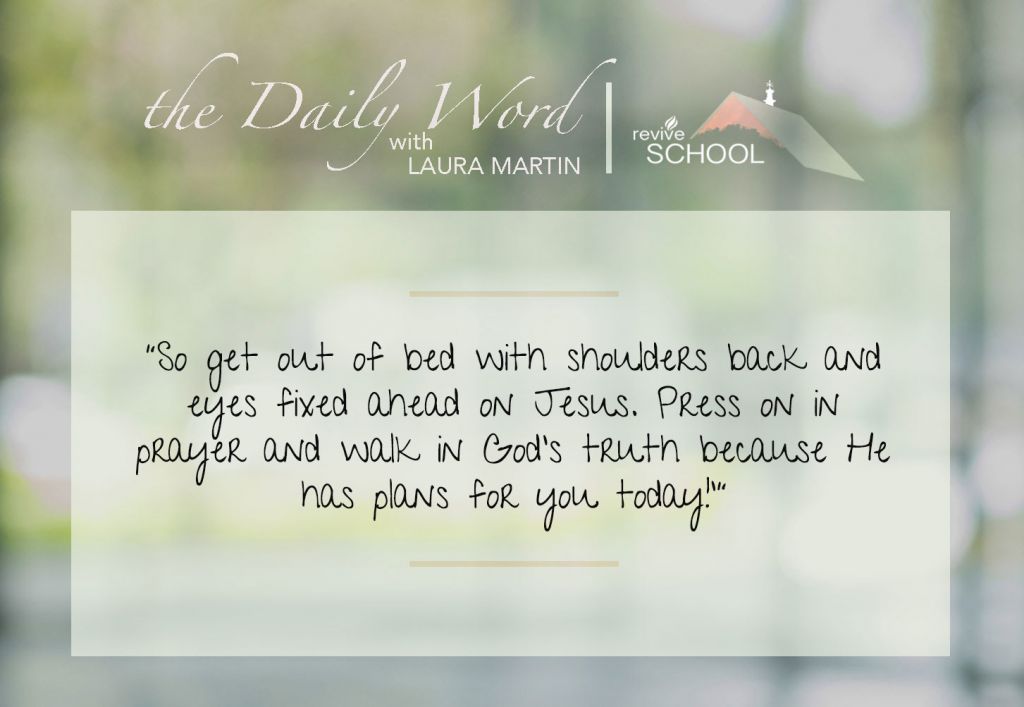
Today, remember, you were formed in your mother’s womb. You are called, you have purpose, and you have a destiny on your life. You are not here by chance. God has a plan for your life. You are honored in the sight of the Lord. The Lord will be your strength. Whether you are praying for your own child or are seeking the Lord as His child, believe this truth: You are perfectly and wonderfully made. You were formed in your mother’s womb for such a time as this. Concerns and uncertainties may arise, but remember, the Lord has called you and those you love by name. The Lord will redeem your lives for His glory. His hand is on you. So, get out of bed with shoulders back and eyes fixed ahead on Jesus. Press on in prayer and walk in God’s truth because He has plans for you today! You were born with a purpose!
“And now, says the Lord, who formed me from the womb to be His Servant, to bring Jacob back to Him so that Israel might be gathered to Him; for I am honored in the sight of the Lord, and my God is my strength.”
— Isaiah 49:5
FURTHER SCRIPTURE
- Psalm 139:13–16 — “For it was You who created my inward parts; You knit me together in my mother’s womb. I will praise You because I have been remarkably and wonderfully made. Your works are wonderful, and I know this very well. My bones were not hidden from You when I was made in secret, when I was formed in the depths of the earth. Your eyes saw me when I was formless; all my days were written in Your book and planned before a single one of them began.”
- Isaiah 49:1 — “Coastlands, listen to me; distant peoples, pay attention. The Lord called me before I was born. He named me while I was in my mother’s womb.”
- Isaiah 49:7 — “This is what the Lord, the Redeemer of Israel, his Holy One, says to one who is despised, to one abhorred by people, to a servant of rulers: ‘Kings will see and stand up, and princes will bow down, because of the Lord, who is faithful, the Holy One of Israel—and He has chosen you.”
Lesson and Daily Word
Each day has two parts: the Lesson and the Daily Word. Use these buttons to go from one to the other.
Teaching Notes and Questions
Next to the video, these tabs show the Teaching Notes and the Questions. Your answer to a question saves when you leave the answer box.
The Bible passage
This link opens the passage on Bible Gateway, and that gives the passage its tick. If you read it in your own Bible, tick it by hand in Progress.
Your progress on this lesson
A part ticks itself when you play the video or audio to the end, read the notes or the Daily Word to the end, or answer every question. You can also tick a part by hand here.
Downloads
Here you can save the video, the audio and the lesson as PDF files. Downloads do not count toward your progress.
Need help?
Use this button to send us a question or tell us about a problem. You can also take this tour again from there.