

God's People Comforted
Discover Jesus as: Immanuel Isaiah 39-40 Read on Bible Gateway (HCSB)
Lesson
Audio Only
Teaching Notes
INTRO
As we study Isaiah, it’s necessary to keep reviewing what we’ve covered so far. Before we go into Isaiah 40, we’ll need to review chapters 36—39. At the end of chapter 36, and the beginning of chapter 37, Hezekiah put on clothes of mourning and prayed to God. At the end of chapter 37, God replied to Hezekiah’s prayer and intervened in a miraculous way (185,000 Assyrians were killed in their camp, Hezekiah 37:36). In chapter 38, Hezekiah became terminally ill, and Isaiah told him to put his affairs in order. In response, Hezekiah cried out to God, reminding God that he had walked faithfully before Him. God responded by giving Hezekiah fifteen more years of life.
In Isaiah 39, things changed. The king of Babylon sent letters and gifts to Hezekiah on behalf of his recovery from his illness. Hezekiah accepted the gifts and showed the bearer (the king’s son) his treasure house with all his riches and his armory (vv. 1-2). When Isaiah found out the men were from Babylon, he told Hezekiah that the day would come when everything Hezekiah had shown these men would be carried off to Babylon (vv. 3-7). Hezekiah responded that it was good because there would be “peace and security” during his life (v. 8).
Charles H. Dyer compared the sections of Isaiah with these differences:1
Isaiah 1-39: | Isaiah 40-66: |
They focus on the threat of the Assyrians. | They focus on the problems with Babylon and actions of Cyrus of Persia. |
Historical details are included. | Historical details are seldom included. |
The Messiah is seen as the shoot of Jesse. | The Messiah is seen as a servant. |
The life of Isaiah is seen prominently. | The life of Isaiah is absent. |
MacArthur explains, “The prophecies of chapters 40—66 address Judah as though the prophesied Babylonian captivity were already a present reality, though that captivity did not begin until 605–586 BC.”2
Wiersbe identifies three divisions within chapters 40—66: chapters 40—48; 49—57; 58—66.3 At the end of chapters 48 and 57, one statement is given that becomes the breaking place between the divisions: “There is no peace for the wicked,” says the Lord.
TEACHING
Isaiah 40:1-11: Wiersbe describes Isaiah’s message in the first 11 verses as, “the circumstances behind us.”4 Isaiah’s message was for God’s prophets, encouraging them to provide comfort to those who would be taken into captivity (vv. 1-2a) (Romans 11:2a). Isaiah states that Jerusalem’s iniquity (chapter 39) had been pardoned. This may point to being set free from Babylonian captivity. Verse 3 refers to the end, when the highway is made straight for the Lord’s return, which foreshadows John the Baptist heralding the coming of Jesus (Matthew 3:1). Isaiah 35:8 refers to His second coming. Obstacles will be removed for His coming (v. 4). All of it will bring glory to the Lord’s appearance (v. 5).
Verses 3-5 are the key to this passage and can be really hard to understand with present, future, and then the second coming all referred to.
I’ve taught very little of chapter 40, but when you read verse 31, it all makes sense: “But those who trust in the Lord will renew their strength; they will soar on wings like eagles; they will run and not grow weary; they will walk and not faint.” When you know where the people of Judah and Jerusalem had been and you know they were headed into Babylonian captivity, then verse 31 documents that they would one day walk in freedom.
1 Charles H. Dyer., and Eugene H. Merrill. The Old Testament Explorer. Nashville: Word Publishing, 2001. Reissued as Nelson's Old Testament Survey. Nashville: Thomas Nelson Publishers, 2001, p. 561; adapted in Thomas L. Constable, Dr. Constable’s Expository Bible Study Notes; Isaiah, p 252; available online at https://planobiblechapel.org/tcon/notes/pdf/isaiah.pdf.
CLOSING
I believe there is a “John the Baptist calling” on many of you to walk ahead and begin to prepare for the Lord’s return. Your job may be to remove obstacles, like false teachers and false teachings. If we want to prepare for the Lord’s second return, we need to be more like John the Baptist. We need to be more radical in our faith and our lives.
John MacArthur, The MacArthur Bible Commentary (Nashville: Thomas Nelson Publishers, 2005), p. 804.
W. Wiersbe, The Bible Exposition Commentary: Old Testament (Colorado Springs, David C. Cook, 2002), p. 48.
Wiersbe, p. 49.
Questions
-
In Isaiah 39, King Hezekiah took the Babylonian convoy and showed them his entire kingdom and riches. In your opinion, did he do this to boast about his riches or was he honestly excited for them to see what he had?
-
In Isaiah 39, King Hezekiah seemed to be okay with God’s discipline because it wasn’t going to affect him. What do you think about that?
-
The prophet Isaiah gave words of comfort to the people in Isaiah 40:1-11. Where else in Scripture is Isaiah 40:3 used? Matthew said Isaiah was speaking of John. How is that possible?
-
Have you ever found yourself relying on the Lord’s strength, as in Isaiah 40:29-31? What were the circumstances and the outcome? How would you best describe how to do this to a new believer?
-
What did the Holy Spirit highlight to you in Isaiah 39—40 through the reading or the teaching?
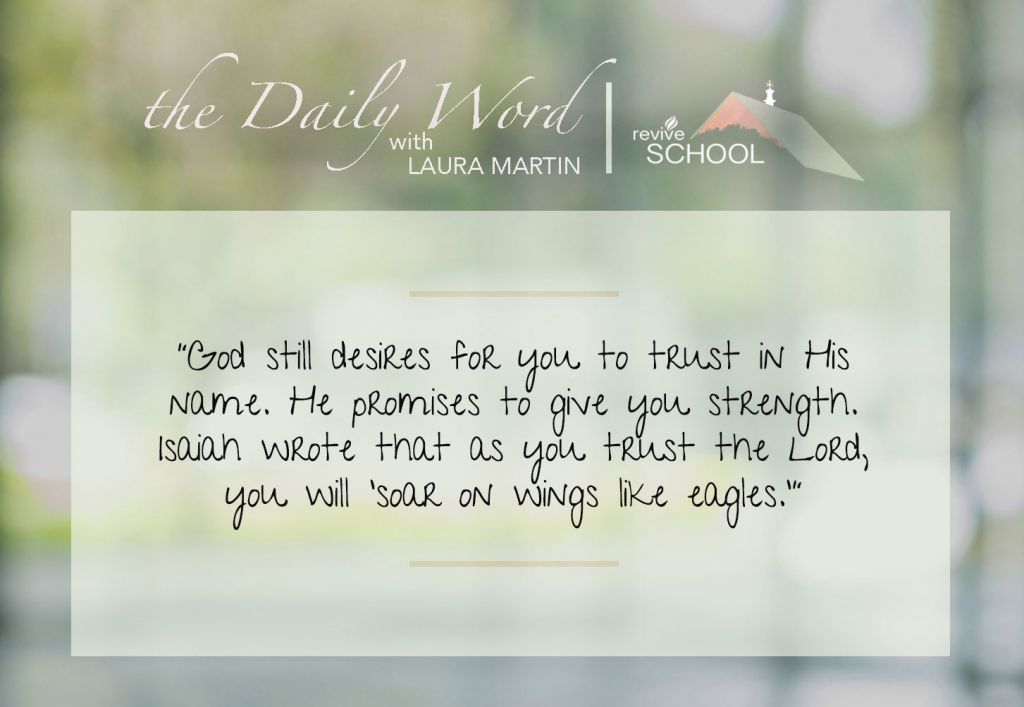
Daily Word
Laura Martin Isaiah 40:28–31
“Do you not know? Have you not heard? Yahweh is the everlasting God, the Creator of the whole earth. He never grows faint or weary; there is no limit to His understanding. He gives strength to the weary and strengthens the powerless. Youths may faint and grow weary, and young men stumble and fall, but those who trust in the Lord will renew their strength; they will soar on wings like eagles; they will run and not grow weary; they will walk and not faint.”
FURTHER SCRIPTURE
- Psalm 62:5–8 — “Rest in God alone, my soul, for my hope comes from Him. He alone is my rock and my salvation, my stronghold; I will not be shaken. My salvation and glory depend on God, my strong rock. My refuge is in God. Trust in Him at all times, you people; pour out your hearts before Him. God is our refuge. Selah”
- Matthew 11:28–30 — “Come to Me, all of you who are weary and burdened, and I will give you rest. All of you, take up My yoke and learn from Me, because I am gentle and humble in heart, and you will find rest for yourselves. For My yoke is easy and My burden is light.”
- Hebrews 13:8 — “Jesus Christ is the same yesterday, today, and forever.”
Lesson and Daily Word
Each day has two parts: the Lesson and the Daily Word. Use these buttons to go from one to the other.
Teaching Notes and Questions
Next to the video, these tabs show the Teaching Notes and the Questions. Your answer to a question saves when you leave the answer box.
The Bible passage
This link opens the passage on Bible Gateway, and that gives the passage its tick. If you read it in your own Bible, tick it by hand in Progress.
Your progress on this lesson
A part ticks itself when you play the video or audio to the end, read the notes or the Daily Word to the end, or answer every question. You can also tick a part by hand here.
Downloads
Here you can save the video, the audio and the lesson as PDF files. Downloads do not count toward your progress.
Need help?
Use this button to send us a question or tell us about a problem. You can also take this tour again from there.