

The Lord Rebuked Jerusalem
Discover Jesus as: Immanuel Isaiah 30-31 Read on Bible Gateway (HCSB)
Lesson
Audio Only
Teaching Notes
INTRO
So far, we’ve seen the pattern of pending judgement coming upon the people, then blessings included in this process, and finally, the repeated message to get ready for the Messiah. Oracles or judgements were repeatedly made against Samaria, Judea, and Assyria. Nelson’s Commentary states, “Isaiah denounces those who seek human support instead of depending upon the Lord [in chapter 29]. In chapter 30 and 31, Isaiah addresses the specific folly of depending on Egypt.”1 For Jerusalem the message was do not depend upon their own strength––do not depend upon Egypt. Isaiah continued to prophesy, while naked, to gain the attention of all who needed to heed his message from God. But Israel continued to make allegiances contrary to God’s will.
TEACHING
Isaiah 30:1-7: Israel attempted to carry out a plan, but it was not of God and not of the Holy Spirit. Israel repeatedly made decisions without seeking God’s guidance, thereby piling sin upon sin. At the advice of Hezekiah’s advisors, they went down to Egypt to seek an alliance (v. 2). Wiersbe stated, “Unlike the leaders of old–– Moses (Numbers 27:1), Joshua (Joshua 9:14), David (1 Samuel 30:7-8), and Jehoshaphat (1 Kings 22:7ff) ––the rulers of Jerusalem did not seek the will of God.”2Nelson’s Commentary explains, “The contrast of course, would be trusting in the ‘shadow of the Almighty’” (Psalm 91:1).3
In verses 3 through 5, Isaiah asked why Israel had made this decision to seek help from Egypt when Israel should have asked Isaiah for his counsel. Nelson’s Commentary states, “His ambassadors may be the people of Judah who went from Zoan (19:11–13), in the Delta of Hanes, some 50 miles south of Cairo.”4 The Israelites carried treasure on the back of animals from Jerusalem to Egypt to pay tribute and to buy their protection against Assyria.
Egypt is compared to Rahab in verse 7: “Rahab, which literally means ‘Storm’ or ‘Arrogant,’ was a dragon from pagan mythology who was pictured as resisting creation. Both Rahab and Leviathan are symbolic of the forces of evil in the universe that God will destroy (51:9)”5 Egypt’s help was worthless.
Isaiah 30:8-17: Isaiah told Judah/Jerusalem to write on a table and inscribe in a scroll that they had not obeyed the Lord’s instructions. Interestingly, “The oldest writing tablets discovered so far can be dated to about 1350 B.C. They were found in
A.D. 1986 in a shipwreck off the coast of southern Turkey. Until this discovery, the oldest tablets were those found in a well at Nimrud, near Nineveh, dating from about 700 B.C.”6 Isaiah accused the people of Israel of telling the seers not to see and the prophets not to prophesy. They did not want to be told anything. They only wanted to hear illusions. The people of Israel want Isaiah to leave them alone. Their most flagrant words come in verse 11 when they told Isaiah to cease prophesying.7
Following the repeated examples of the results of God’s judgement, verse 15 turns to the message of repentance and rest. This repentance required utter trust in the Lord. Nelson’s Commentary explains, “Quietness and confidence may be rephrased as ‘Utter trust’. Trusting in God’s strength instead of our own is the only way we can find true rest.”8
This kind of trust requires waiting. What is the hurry? Why feel rushed? Do not fret but trust in God. Wise planning has value but is not required for faith in God. We should reflect and worship.
Verses 1-17 are all about Israel depending upon Egypt, and Isaiah’s word was simply to stop. But condemnation, then hope, then a promise, and finally a blessing, are all part of Isaiah’s prophesy.
Isaiah 30:18 – 33; These verses promise that the Lord will save Israel and will destroy Assyria. Waiting on the Lord yields a blessing. God promised to hear them at their first cry and to answer them. “The Lord was giving the Israelites meager rations as though they were in prison (1 Kings 22:27). But after judgement the Lord would provide salvation: Israel’s eye would see (29:24). Teachers probably refers to the prophets (v. 10).”9
In verse 21, the people of Israel actually recognized Isaiah as the teacher and that the teacher was telling them which way to go: “The people had been living in such a way they were oblivious to their spiritual teachers (v. 20); now they would be taught by the Spirit of the living God.”10
The result is that the people would start to get rid of stuff (v. 22), and God’s blessing would extend from fields to flocks (v. 23). The impact of the coming salvation is illustrated in verses 23-26. Nelson’s Commentary explains, “These phrases emphasize the magnitude of the coming salvation. The coming of ample rainfall and strong streams are associated with the blessing that comes from trust in God (32:2; 41:17,18).”11
In verses 27-33, Isaiah addressed the destruction of Assyria. Nelson’s Commentary states, “The prediction of Assyria’s destruction consists of two cycles: (1) one of attack (vv. 27, 28, and 30, 31), and (2) one of rejoicing (v. 29 and v. 32).”12
Wiersbe explains, “Just as Sheol was prepared for the King of Babylon (Isaiah 14:9ff), so Topheth was prepared for the King of Assyria. Topheth was a site outside of Jerusalem where the worshippers of Molech sacrificed their children (2 Kings 16:3; 21:6; Jeremiah 7:31-32; 19:6, 11-14).”13 Topheth is a symbolic image of hell.
CLOSING
These verses have a similarity to Armageddon and Christ’s second coming. Jerusalem turned to the Lord. They cried out to God. Finally, there was a battle and sacrifices where the King of Assyria ended in Topheth, which was later known as Gehenna or Hell. Ultimately the promise of God prevails.
Earl Radmacher, Ronald B. Allen, and H. Wayne House, eds., Nelson’s New Illustrated Bible Commentary (Nashville: Thomas Nelson Publishers, 1999), p.837.
Warren W. Wiersbe, The Bible Exposition Commentary: New Testament (Colorado Springs, David C. Cook, 1989), p.37.
Nelson’s Commentary, p. 837.
Nelson’s Commentary, p. 837.
Nelson’s Commentary, p. 837..
Nelson’s Commentary, p. 837.
Nelson’s Commentary, p. 837.
Nelson’s Commentary, p. 837.
Nelson’s Commentary, p. 837.
Nelson’s Commentary, p. 837.
Nelson’s Commentary, p. 837.
Nelson’s Commentary, p. 837.
Wiersbe, p. 38.
Questions
-
Isaiah 30:1-5 speaks about trusting Pharaoh instead of God. By doing this, the people of Judah and Jerusalem faced humiliation, disgrace, and shame. Has there been a time when you trusted someone other than God? Did you experience these same emotions? What was your outcome?
Daily Word
Laura Martin Isaiah 30:18
“Therefore the LORD is waiting to show you mercy, and is rising up to show you compassion, for the LORD is a just God. All who wait patiently for Him are happy.”
Even after judgment, even after destruction, Isaiah continued to encourage the people of Israel with this truth—the Lord is waiting for you. He is waiting to show you mercy and compassion. He cares for you.
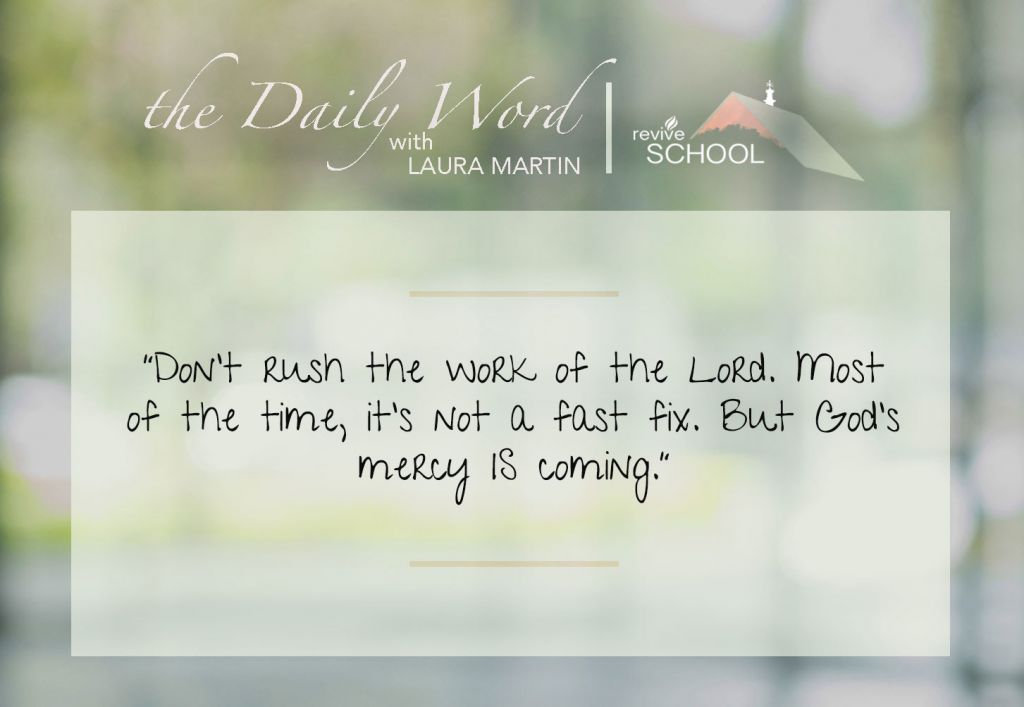
God’s mercies never end. Just as sure as the sun rises, the Lord’s mercies are new each day. Wait patiently through the hardship you may be going through, and you will be happy. Your life may feel shattered in millions of pieces, you may feel broken beyond repair, but friend, God is the God who will make beauty from the ashes, beauty from the bro- ken pieces. He will turn them into something beautiful for His glory. Don’t rush the work of the Lord. Most of the time, it’s not a fast fix. But God’s mercy is coming. Draw near to the Lord today, and the next day, and the day after that. No matter what situation you have fallen into, the Lord wants to shower you with His mercy and His compassionate love. Wait for Him. Wait patiently, and you will be happy.
“Therefore the Lord is waiting to show you mercy, and is rising up to show you compassion, for the Lord is a just God. All who wait patiently for Him are happy.”
— Isaiah 30:18
FURTHER SCRIPTURE
- Isaiah 30:12-15 — “Therefore the Holy One of Israel says: ‘Because you have rejected this message and have trusted in oppression and deceit, and have depended on them, this iniquity of yours will be like a spreading breach, a bulge in a high wall whose collapse will come in an instant—suddenly! Its collapse will be like the shattering of a potter’s jar, crushed to pieces, so that not even a fragment of pottery will be found among its shattered remains— no fragment large enough to take fire from a hearth or scoop water from a cistern.’ For the Lord God, the Holy One of Israel, has said: ‘You will be delivered by returning and resting; your strength will lie in quiet confidence. But you are not willing.’”
- Joel 2:13 — “Tear your hearts, not just your clothes, and return to the Lord your God. For He is gracious and compassionate, slow to anger, rich in faithful love, and He relents from sending disaster.”
- James 4:8 — “Draw near to God, and He will draw near to you. Cleanse your hands, sinners, and purify your hearts, double-minded people!”
Lesson and Daily Word
Each day has two parts: the Lesson and the Daily Word. Use these buttons to go from one to the other.
Teaching Notes and Questions
Next to the video, these tabs show the Teaching Notes and the Questions. Your answer to a question saves when you leave the answer box.
The Bible passage
This link opens the passage on Bible Gateway, and that gives the passage its tick. If you read it in your own Bible, tick it by hand in Progress.
Your progress on this lesson
A part ticks itself when you play the video or audio to the end, read the notes or the Daily Word to the end, or answer every question. You can also tick a part by hand here.
Downloads
Here you can save the video, the audio and the lesson as PDF files. Downloads do not count toward your progress.
Need help?
Use this button to send us a question or tell us about a problem. You can also take this tour again from there.