

Judgment Against Egypt
Discover Jesus as: Immanuel Isaiah 19-20 Read on Bible Gateway (HCSB)
Lesson
Audio Only
Teaching Notes
INTRO
Of the 66 chapters in Isaiah, the first 39 are on judgment and the last 27 on comfort and redemption. This picture compares with the 39 books of the Old Testament and 27 books of the New Testament, with judgment in the Old Testament and Christ coming to redeem us in the New Testament. In the first 12 chapters of Isaiah, there are prophecies concerning Judah and Jerusalem. Judah is in the Southern Kingdom. The Northern Kingdom was composed of the other ten tribes. While some of the other (minor) prophets spoke to the Northern Kingdom, Isaiah’s message was to the Southern Kingdom. Chapters 13-23 include oracles, or woes, against the nations that interacted with Judah. Yesterday, it was Ethiopia and Cush. Today, chapter 19 includes an oracle against Egypt because of its role against Judah. In the first 15 verses, judgment was coming against Egypt. According to Wilbur Smith, Isaiah 19 “contains the most important prophetic utterance concerning Egypt in all of the Old Testament . . . for Isaiah declares that the three enemies—Egypt, Israel, and Assyria (modern Iraq)—will one day be united in worshipping the Lord and sharing His blessing!”1
TEACHING
Isaiah 19:1-4: The image of the Lord riding on a swift cloud reminds us of our word for this book: Immanuel, which means “God with us.” Matthew 26:64 also describes Jesus coming on the clouds of heaven. Again, Isaiah leaves us wondering if this was a prophecy of something that will happen “now” or “then.” Was he talking about the first coming of Jesus or His second coming? Judgment was coming, and Egypt would tremble in fear. Egyptians would also fight against each other. Warren Wiersbe wrote: “The 42 provinces of Egypt, called “nomes,” would be thrown into disarray and start fighting each other.”2 Though Egypt would begin to seek idols and spiritists, God would deliver them to harsh rulers (vv. 3-4). According to Nelson’s Commentary, “the failure of Egypt’s many gods result[ed] in anarchy.”3 Just as the Israelites had dealt with Egypt as a harsh master, Egypt would be subjected to a harsh master.
Isaiah 19:5-10: Nelson’s Commentary also points out that “the failure of the Nile [led] to economic collapse.”4 Egypt’s whole economy was based on the Nile River, so when the river dried up (vv. 5-7), the economy was devastated: the fishermen would mourn (v. 8); those who worked with flax would be dismayed (v. 9); and weavers and wage earners would be demoralized (v.10). Without the bounty of the river, the people would have nothing to do to earn a living. Everyone in Egypt, from owners to wage earners, would be impacted.
Isaiah 19:11-15: The Egyptians depended upon their own wisdom, insight, and intellectualism; but none of their wise men could explain what was happening to them. Nelson’s Commentary says, “The failure of its ancient and vaunted wisdom result[ed] in hopeless defeat.”5 The Egyptians could no longer depend on their own man-made strategy and insight. The political and economic systems would be destroyed. Wiersbe added that the religious and wisdom systems were destroyed. The wisdom and intelligence of Egypt’s advisers failed in the face of God’s judgment. In Mark 6:2, the wisdom of the religious leaders paled in comparison to Jesus’ teaching in the synagogue, “many who heard Him were astonished” and wondered, “What is this wisdom given to Him, and how are these miracles performed by His hands?”
Isaiah 19:16-25: “On that day” (v. 16), is mentioned many different times (vv. 18, 19, 23, 24). Five different times, Isaiah says “on that day,” something will happen. Wiersbe pointed out that “Egypt will fear Israel (vv. 16-17).”6 The once domineering nation of Egypt would then fear Israel.
Egypt will then “speak the language of Canaan” (v. 18). Egypt will actually be converted to worshipping the Lord in Hebrew. Egypt will establish an altar and a pillar to the Lord (v. 19). The altar and pillar allude to Abraham and Jacob. In Genesis 12:8, Abraham built an altar to the Lord in Bethel. In Genesis 28:22, Jacob set a stone or marker as God’s house and pledged to give God a tenth of all God had given him. “On that day” (v. 19), the Egyptians will “take a pledge of allegiance to the Lord.”7 When Egypt cries out to God, He will hear them and heal them (vv. 20-22).
In his prophecy against Egypt, Isaiah made a drastic flip from saying that judgment was coming to Egypt to saying Egypt would fear Israel and be converted, to worship the true God. Since Muslims live in Egypt, this picture is of radical revival with Muslims turning to Yeshua—to Jesus. When Christ comes and establishes His Messianic Kingdom on earth, these things will take place. So this prophecy doesn’t refer to Jesus’ first coming (the time of His death, burial, and resurrection), but to His second coming, when He establishes His kingdom permanently.
“On that day” (v. 23), Egypt will worship with Assyria. Furthermore, “on that day” (v. 24), Israel, Egypt, and Assyria will form a triple alliance and God will bless them all. There will be unity among multiple countries and people groups. According to Nelson’s Commentary, this signifies the removal of the alienation and separation of the countries.8
“On that day,” Egypt will fear Israel. Egypt will be converted and worship the true God, speaking the language of Canaan (Hebrew). Egypt, Assyria, and Israel will be a blessing to other nations.9Genesis 12:3 begins to come to fruition, where God promised to bless the nations through Israel.
Isaiah 20:1-6: Isaiah had just said these three countries would be a blessing to the nation (Isaiah 19:24-25). But now Isaiah reiterated what he had just said in Isaiah 19:1-15. Isaiah gave a warning to Judah, trying to get their attention, to say that all of the hope they had in Egypt and Cush (Ethiopia,) during the time of the Southern Kingdom, would not help them. Instead, those countries would experience judgment and anarchy and economic collapse and hopeless defeat. Isaiah urged Judah not to put their hope in man. As a visible demonstration, Isaiah walked around naked and barefoot for three years to show the hopelessness for those manmade alliances. Isaiah warned Judah that their allies were destined to fall. The only way the thick- headed people of Judah would believe this message was because Isaiah walked around naked for three years to prove his point. Isaiah was a radical prophet who wanted to get his people’s attention.
CLOSING
Isaiah 13-23 contain oracles against the nations. But in today’s lesson, we saw that even though the nations will be judged, Egypt specifically will be saved and blessed. But Isaiah warned Judah not to put stock in their allies because they were going to fall.
Warren W. Wiersbe, The Bible Exposition Commentary: Old Testament (Colorado Springs, David C. Cook, 2002), p. 1167.
Wiersbe, p. 1167.
Earl Radmacher, Ronald B. Allen, and H. Wayne House, eds., Nelson’s New Illustrated Bible Commentary (Nashville: Thomas Nelson Publishers, 1999), p. 828.
Nelson’s Commentary, p. 828.
Nelson’s Commentary, p. 828.
Wiersbe, p. 1167.
Nelson’s Commentary, p. 828.
Nelson’s Commentary, p. 828.
Wiersbe, p. 1167.
Questions
-
In your opinion, what and when is Isaiah 19:1-2 talking about? Where else in Scripture is Jesus described as riding on a cloud? (Exodus 24:16; Acts 1:9; Revelation 14:14)
Daily Word
Laura Martin Isaiah 20:2-3
“During that time the LORD had spoken through Isaiah son of Amoz, saying, ‘Go, take off your sackcloth and remove the sandals from your feet,’ and he did so, going naked and barefoot—the LORD said, ‘As My servant Isaiah has gone naked and barefoot three years as a sign and omen against Egypt and Cush.’”
The Lord needed to get Egypt’s attention again—to remind the people to trust in God alone. Again, God called upon the prophet Isaiah and gave him clear instructions: Go naked and barefoot for three years as a symbol representing disgrace and need in Egypt. Isaiah radically obeyed the Lord by going naked and barefoot for the sake of others turning to the Lord.
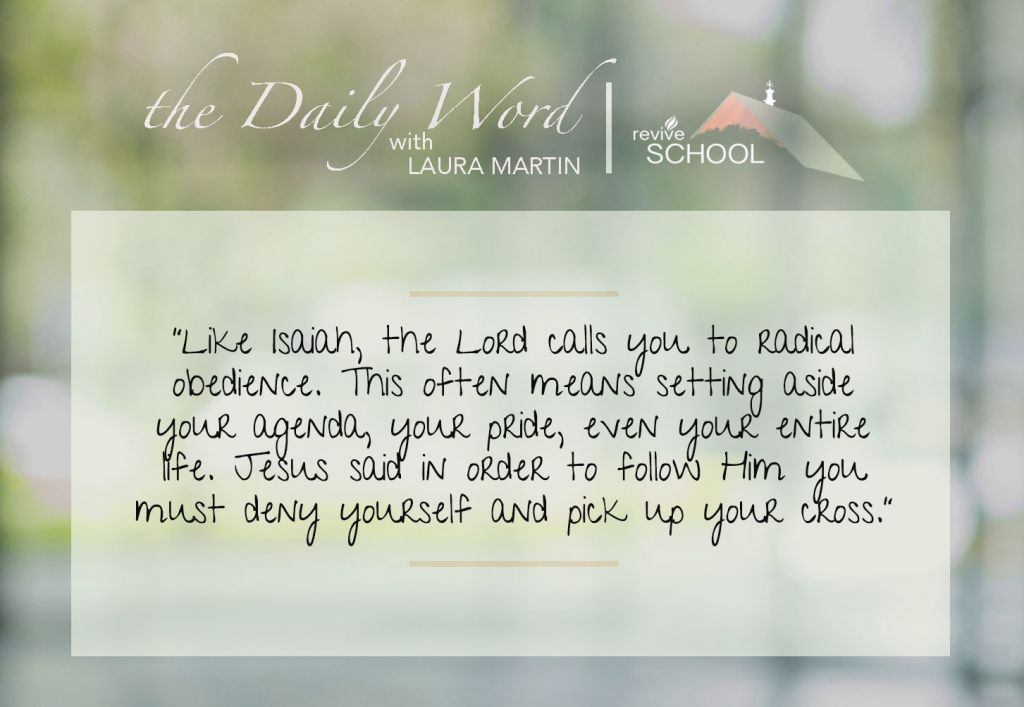
Like Isaiah, the Lord calls you to radical obedience. This often means setting aside your agenda, your pride, even your entire life. Jesus said to follow Him you must deny yourself and pick up your cross. Is there something radical the Lord has put on your heart to do for the sake of the Gospel? The prophet Joshua gathered the people to walk around Jericho’s walls for six days, and then on the seventh day, they gave a mighty shout. Just as God promised the city walls came tumbling down after their obedience. Perhaps you sense the Lord asking you to prayer walk around your home, seek reconciliation and forgiveness, fast from lunch at the office for a month, or give up your home or even your job. Don’t dismiss what’s on your heart. As you walk in this radical obedience like Isaiah, it could foster a change in someone’s life, or even an entire country. Don’t miss out on what the Lord wants to do in and through you!
“During that time the Lord had spoken through Isaiah son of Amoz, saying, ‘Go, take off your sackcloth and remove the sandals from your feet,’ and he did so, going naked and barefoot—the Lord said, ‘As My servant Isaiah has gone naked and barefoot three years as a sign and omen against Egypt and Cush.’”
— Isaiah 20:2-3
FURTHER SCRIPTURE
- Joshua 6:2-5 — “The Lord said to Joshua, ‘Look, I have handed Jericho, its king, and its fighting men over to you. March around the city with all the men of war, circling the city one time. Do this for six days. Have seven priests carry seven ram’s-horn trumpets in front of the ark. But on the seventh day, march around the city seven times, while the priests blow the trumpets. When there is a prolonged blast of the horn and you hear its sound, have all the people give a mighty shout. Then the city wall will collapse, and the people will advance, each man straight ahead.’”
- Matthew 16:24 — “Then Jesus said to His disciples, ‘If anyone wants to come with Me, he must deny himself, take up his cross, and follow Me.’”
- 2 John 1:6 — “And this is love: that we walk according to His commands. This is the command as you have heard it from the beginning: you must walk in love.”
Lesson and Daily Word
Each day has two parts: the Lesson and the Daily Word. Use these buttons to go from one to the other.
Teaching Notes and Questions
Next to the video, these tabs show the Teaching Notes and the Questions. Your answer to a question saves when you leave the answer box.
The Bible passage
This link opens the passage on Bible Gateway, and that gives the passage its tick. If you read it in your own Bible, tick it by hand in Progress.
Your progress on this lesson
A part ticks itself when you play the video or audio to the end, read the notes or the Daily Word to the end, or answer every question. You can also tick a part by hand here.
Downloads
Here you can save the video, the audio and the lesson as PDF files. Downloads do not count toward your progress.
Need help?
Use this button to send us a question or tell us about a problem. You can also take this tour again from there.