

Living By Faith
Discover Jesus as: High Priest Hebrews 11 Read on Bible Gateway (HCSB)
Lesson
Audio Only
Teaching Notes
INTRO
In Hebrews 1—10 we looked at old versus new, and it has been a heavy study. Jesus is greater than any high priest the Jews had known. The new covenant is superior to the old covenant. The heavenly sanctuary is better than the sanctuaries built on earth. Wiersbe says chapters 1—6 are about “a superior person,” Jesus, chapters 7—10 are about “a superiorpriesthood,” and chapters 10—14 are about “a superior principle—faith.”1 Hebrews 11:6 states, “Now without faith it is impossible to please God, for the one who draws near to Him must believe that He exists and rewards those who seek Him.” As believers, if we’re not functioning in faith, we’re functioning in fear, flesh, and false beliefs. Chapter 11 is all about people in Scripture who walked in faith.
TEACHING
Hebrews 11:1-3: The first three verses explain faith. Faith is “the reality” or substance, the “proof” or the evidence, and the “seen” or the witnessed (v. 1). The reality speaks to those things that can be seen or touched tangibly. J. Oswald Sanders says, “Faith enables the believing soul to treat the future as present and the invisible as seen.”2 The first three verses set the stage for the roster of the faithful to come and what Hebrews 12:1 refers to as “a large cloud of witnesses.” These people stepped out in faith in a way that allowed God’s plan to take place. Noah may never have even seen rain before, but he worked on building the ark for years. That’s either insanely stupid or an obedient act of faith. Sometimes fear of embarrassment or looking like a fool stops us from walking out things in faith.
Verse 2 states the Jewish ancestors had won God’s approval through their faith. It was their faith, not their actions, that God sought. We tend to limit God’s approval in our lives because we don’t want to even approach verse 1. By faith we can understand that God created the world and the universe with what cannot be seen (v. 3). We all function in faith at some level. Even to not believe in God is a statement of faith—having the faith to believe there can be no God. What God wants from us is to function in faith in a way that He can be seen in us.
Wiersbe explains the people who are listed in chapter 11 all shared four elements in their faith: “(1) God spoke to them through His Word; (2) their inner selves were stirred in different ways; (3) they obeyed God; (4) He bore witness about them.”3 The Lord confirmed what they were doing, even when they didn’t see the results.
Faith requires obedience. That doesn’t mean that obedience is easy. When we decided to do Revive School and teach/record 730 lessons in two years, we knew it wouldn’t be easy. But it was in obedience to what God had called us to do. Walking by faith, walking on the narrow path, is super hard. It might cost you friends and business because some people will find it offensive.
Hebrews 11:4-40: The demonstration of how faith was walked out is presented in the rest of the chapter. Hebrews 11 is a real reality check if you’re a follower of Christ. It’s not about church attendance, but it’s about functioning in faith.
- Because of his faith, God approved Abel’s better sacrifice (v. 4). Abel’s faith was seen in his worship. His legacy was preserved for all time through Scripture. Wiersbe states, “Abel was a righteous man because of faith.”4
- In verse 5 Enoch’s faith was seen in how he walked his faith out. Reread verse 6 and then read Revelation 22:12.
- Noah’s faith was seen in how he worked for a hundred years on what he couldn’t understand (v. 7). You wonder if Noah even knew carpentry before he started. Imagine what the neighbors must have thought as they watched Noah work.
- Abraham’s faith was seen in how he relocated to a place he had never seen because God told him to, and in how he waited for years for his inheritance by having a child with Sarah (vv. 8–12). Verse 9 says he was looking forward to a city that had foundations that had been designed and built by God—the New Jerusalem.
CLOSING
Look at all the people in Hebrews 11 that we didn’t get to: Isaac, Jacob, Joseph, Moses, Rahab, Gideon, Barak, Samson, Jephthah, David, Samuel, and the prophets, and others who were left unnamed. All of these were people walking in faith. All of these received God’s approval because of their faith.
When we’re walking out our faith in the Lord, there is no guarantee we’ll ever see what He has promised while living this life (v. 39). But we have to act as though we’re going to see it. That’s the evidence of our faith and it determines how we walk it out.
Warren W. Wiersbe, The Bible Exposition Commentary, Vol. II, (Colorado Springs, David C. Cook, 1989), p. 275.
J. Oswald Sanders; quoted in Wiersbe, p. 318.
Wiersbe, p. 318.
Wiersbe, p. 318.
Questions
-
How would you explain Hebrews 11:1 to an unbeliever? What would be some examples of faith?
-
Who else besides the ones mentioned in Hebrews 11 has shown great faith in the Lord? How did he or she show it?
-
Why do you think it is impossible to please the Lord without faith? How can someone increase his or her faith? (Luke 17:5-10; Romans 10:17)
-
What did the Holy Spirit highlight to you in Hebrews 11 through the reading or the teaching?
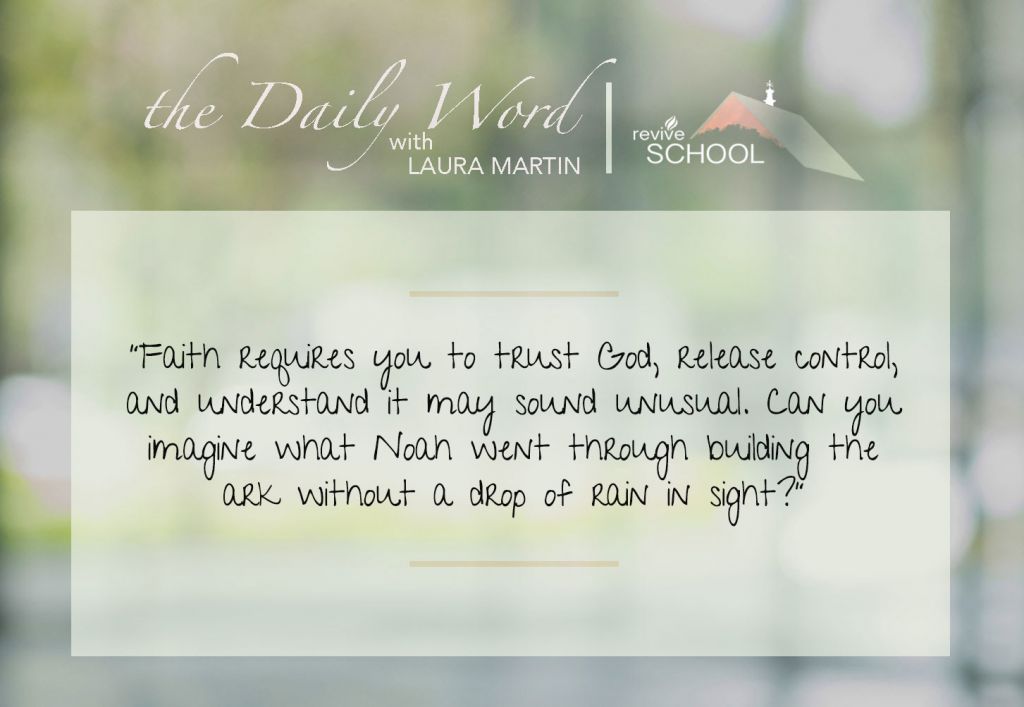
Daily Word
Laura Martin Hebrews 11:1–2
“Now faith is the reality of what is hoped for, the proof of what is not seen. For our ancestors won God’s approval by it.”
FURTHER SCRIPTURE
- Proverbs 3:5–6 — “Trust in the Lord with all your heart, and do not rely on your own understanding; think about H in all your ways, and He will guide you on the right paths.”
- Hebrews 10:39 — “But we are not those who draw back and are destroyed, but those who have faith and obtain life.”
- Hebrews 11:6–7 — “Now without faith it is impossible to please God, for the one who draws near to Him must believe that He exists and rewards those who seek Him. For by faith Noah, after he was warned about what was not yet seen and motivated by godly fear, built an ark to deliver his family. By faith he condemned the world and became an heir of the righteousness that comes by faith.”
Lesson and Daily Word
Each day has two parts: the Lesson and the Daily Word. Use these buttons to go from one to the other.
Teaching Notes and Questions
Next to the video, these tabs show the Teaching Notes and the Questions. Your answer to a question saves when you leave the answer box.
The Bible passage
This link opens the passage on Bible Gateway, and that gives the passage its tick. If you read it in your own Bible, tick it by hand in Progress.
Your progress on this lesson
A part ticks itself when you play the video or audio to the end, read the notes or the Daily Word to the end, or answer every question. You can also tick a part by hand here.
Downloads
Here you can save the video, the audio and the lesson as PDF files. Downloads do not count toward your progress.
Need help?
Use this button to send us a question or tell us about a problem. You can also take this tour again from there.