
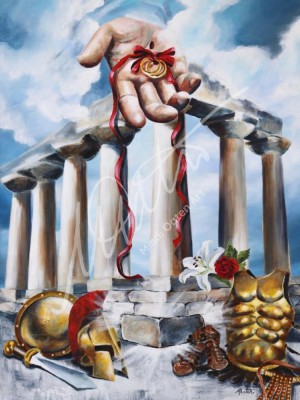
A Brick In The Temple
Discover Jesus as: The Head Ephesians 2 Read on Bible Gateway (HCSB)
Lesson
Audio Only
Teaching Notes
INTRO
Paul wrote Ephesians to be read aloud to all the churches. Would you read a letter you just received one paragraph at a time? Of course not. Therefore, these letters need to be read in completion in ONE sitting. I would encourage you to read it aloud as well, because the letter is best understood that way. It is incredibly important to get the whole concept of the letter before
breaking it down into sections to study. Paul painted two pictures for us: (1) before Christ in verses 1–3, and (2) after Christ in verses 4–6. This picture is the transformation from death to life and is at the very heart of who we were and are.
TEACHING
Ephesians 2:1-3: Paul used the word dead to describe how black the before picture was (v. 1). That death was the result of sin. Sin kills. It destroys. It annihilates. Some commentators note that Ephesians deals more with the spiritual realm and its forces than any other New Testament book. God wants you alive; Satan wants you dead. This struggle is the war we all must face (v. 2). Paul emphasized that we too lived under the same condition (v. 3). Culture defines freedom as the ability to do anything we want. The problem with that is our sinful state. The things we want are ultimately self-destructive. These cravings are so strong they’ll cause us to rationalize everything from premarital sex and extramarital sex to running red lights or eating just one more Hershey’s Kiss.
Paul described humankind as “by nature children under wrath.” Wrath is God’s holy anger against sin and judgment that results from sin. God hates sin, and He despises what sin does in our lives. But we tend to see the wrath of God in opposition to the love of God. Therefore, we feel forced to choose between them, and we opt to focus on God’s love. In fact, the two are not opposites but are two sides of the same coin. God cannot be completely loving if He does not hate the things that rob us of life.
Ephesians 2:4–6: If God didn’t love us, He wouldn’t care about the consequences of sin in our lives. We WERE dead, and we gratified our sinful nature with our fleshly desires. Note the word dead is not the focus of the sentence. We WERE dead, BUT death no longer holds on to us. We have hope found only in Jesus Christ. Paul began verse 4 with “BUT.” Our merciful and loving God, because of the “love with which He loved us” (NASB), has made us alive (vv. 4-5). The penalty has been paid, and our bondage to sin has been broken forever. Not only have we been saved, God has also raised us from death in sin to life and has seated us with Christ in the heavens (v. 6).
Ephesians 2:7–10: Why would God do such a thing? God did it to show the world what He is like (v. 7). We are God’s visual aid. When people look at us, they should see the reflection of the gift of love and salvation we have received. Verses 8–9 are the heart of the book of Ephesians, and they are the blue area on the TTR wristbands. Memorize these verses because they powerfully state the incredible message of salvation—salvation is by grace through faith. We are not saved BY works, but FOR works, not because we were told to, but in response to God’s mercy (v. 10).
Put together the before and the after—we were purchased by Christ’s life, death, and resurrection:
- We WERE dead, but NOW we are alive.
- We WERE unrighteous, but NOW we have been purified.
- We WERE objects of wrath, but NOW we stand before God forgiven.
In light of that, the church—as Christ’s greatly loved bride—gets to do the hard and heart work of evangelism and missions. It’s a costly, messy, much-resisted work that God has given us to do, but it’s worth all the sacrifice, tears, and conflict. Is your spiritual life the before picture or the after picture? If before, I challenge you to read verses 8–10 every day this week. May God’s Holy Spirit reveal what these verses mean in a real-life way. If after, anticipate the good works God has prepared for you this week. Look around to see what opportunities God has for you.
Ephesians 2:11–12: You have been chosen by God to be a metaphorical brick in His house. We should be the best building materials. But, before Christ, our lives were a barrier. The walls and dividers that separate us from God are real, both religious and sociological. The Jews were conscious of the privileges they had inherited, and the physical walls that separated them from all other peoples. Even in the temple, walls were built that separated the Jews from the Gentiles. Circumcision was the external sign of their special relationship with God. We were also separated from God by our sin (vv. 1–10).
Ephesians 2:13–18: “But now” reminds us the walls have been removed and the barriers between us and God are no more (vv. 13–14). Through Jesus’ death, He reconciled (made peace) the Jews and the Gentiles to each other. The point is, Jesus came to tear down, destroy, and abolish the walls that separated us from one another in order to make us into one new, united people as His children. Our call is to stand for God’s truth and to live and minister in God’s grace.
Ephesians 2:19–22: Paul reminds his readers they are citizens of God’s kingdom with all the rights and privileges that go with that citizenship. That means we are not two bodies—we are one. We are both the body of Christ and the temple of God as a dwelling place for the Holy Spirit. Mindi’s painting shows the glory of God coming from the cornerstone, the stone Isaiah described as “a tested stone, a precious cornerstone, a sure foundation” and said that “the one who believes will be unshakable” (Isaiah 28:16). The cornerstone was the most important part of the structure and was carefully chosen as the strongest and the truest. The cornerstone set the direction of the building, supported its weight, and tied the rest of the structure together. That is exactly who Jesus is to us as the church—the One who ties us all together and holds us together (v. 21). As believers, we are a part of that building/temple, because that is where God abides.
CLOSING
If you are a brick, how do you see yourself? Are you someone who goes to church, or are you someone who is the church? There is a huge difference between those two questions, and it is crucial to know your answer. There are people who just go to church, and then go home, and continue on with their daily lives unaffected.
But everything HAS changed. Christ died for us, His bride, in order for us to BE His church.
Jesus died for us to fill the God-shaped vacuum in our lives. That’s the good news.
Jesus died for us so we can do the good works He prepared in advance for us to do, to fill the purpose-shaped vacuum in our lives.
Jesus made us a brick and includes us as part of the holy temple.
We are God’s workmanship who were created in Christ Jesus to do good works, works God has prepared for us to do in advance. Be a brick!
Questions
-
Read Ephesians 2:1 and Romans 6:23a. Describe the death Paul spoke about in theses verses.
-
In Ephesians 2:8–9, Paul taught that by grace we are saved through faith, not from works. How then are we to understand the good works mentioned in Ephesians 2:10 (Romans 9:32; 1 Timothy 6:18; Hebrews 10:24; James 2:26; 3:13)?
-
Is the peace mentioned in Ephesians 2:14 available to other hostile groups? What are some groups that are often hostile toward one another? Do you view Ephesians 2:16 as a message of hope to other groups besides Jews and Gentiles (Galatians 3:28)? What is the greatest enmity that has been reconciled (Romans 8:7–9; Ephesians 2:13; Colossians 2:13–14)?
-
Ephesians 2 informs us that Christ is our peace and He came and preached (proclaimed) peace. What is the first message of peace proclaimed in the New Testament (Luke 1:79; 2:10–14)? Where in the gospels can you find Jesus speaking of peace?
-
What did the Holy Spirit highlight to you in Ephesians 2 through the reading or the teaching?

Daily Word
Laura Martin Ephesians 2:14
“For He is our peace, who made both groups one and tore down the dividing wall of hostility.”
God, who is rich in mercy and lavish in His grace, is also your peace. Christ came to be peace to those who believe by faith. When you rest in the Lord alone, when you cease striving, when you take a deep breath and humbly surrender your will with thanks, then Christ will be your peace. Open your hands and lift them up. Pray to the Lord: “I believe in You. I receive Your mercy. I receive Your grace. I receive Your love.”
God has everything in His hands—the issues, the worries, the problems, and the heartaches. Christ came so you may have peace. He is the one and only true assurance for peace in your life, the only authentic peace found in this world. Only Jesus. Nothing else will bring you peace. Nothing. Therefore, stop searching and receive Him. Then slow down long enough to rest in His peace. Give Him thanks at all times for His peace.
“For He is our peace, who made both groups one and tore down the dividing wall of hostility.”
— Ephesians 2:14
FURTHER SCRIPTURE
- Psalm 85:8 — “I will listen to what God will say; surely the Lord will declare peace to His people, His godly ones, and not let them go back to foolish ways.”
- John 16:33 — “I have told you these things so that in Me you may have peace. You will have suffering in this world. Be courageous! I have conquered the world.”
- Ephesians 2:17 — “When the Messiah came, He proclaimed the good news of peace to you who were far away and peace to those who were near.”
Lesson and Daily Word
Each day has two parts: the Lesson and the Daily Word. Use these buttons to go from one to the other.
Teaching Notes and Questions
Next to the video, these tabs show the Teaching Notes and the Questions. Your answer to a question saves when you leave the answer box.
The Bible passage
This link opens the passage on Bible Gateway, and that gives the passage its tick. If you read it in your own Bible, tick it by hand in Progress.
Your progress on this lesson
A part ticks itself when you play the video or audio to the end, read the notes or the Daily Word to the end, or answer every question. You can also tick a part by hand here.
Downloads
Here you can save the video, the audio and the lesson as PDF files. Downloads do not count toward your progress.
Need help?
Use this button to send us a question or tell us about a problem. You can also take this tour again from there.