
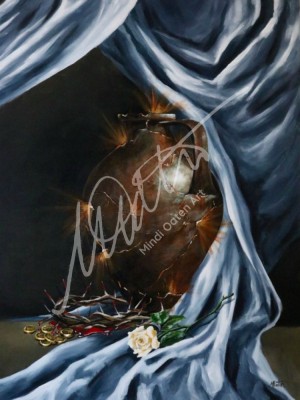
Treasure In Clay Jars
Discover Jesus as: Treasure 2 Corinthians 4 Read on Bible Gateway (HCSB)
Lesson
Audio Only
Teaching Notes
INTRO
Paul dealt with a lot of conflict and a lot of other voices that breathed into the church at Corinth. As a result, Paul had plenty of reasons to be discouraged, but he refused to give up. At the beginning and the end of chapter four, he wrote, “We do not give up.” Why? Because he knew who his Treasure was. Remember, Treasure is our word for who Jesus is in 2 Corinthians. That treasure was what Paul possessed in Jesus Christ.
TEACHING
2 Corinthians 4:1: Verse 1 builds off chapter 3. Because Paul had this ministry and was shown mercy, he refused to give up. That is the theme of this chapter. What did “this ministry” look like, as Paul described it in chapter 3? This was a “ministry of death” (2 Corinthians 3:7), a “ministry of the Spirit” (2 Corinthians 3:8), and a “ministry of righteousness” (2 Corinthians 3:9). This ministry kept Paul from being a quitter.1 Paul confessed early in this letter to the Corinthians that all the news he was receiving and all he was facing had brought him to despair (2 Corinthians 1:8).
2 Corinthians 4:2–4: This ministry kept Paul from being a deceiver.2 Warren Wiersbe pointed out: “You can prove anything by the Bible, provided you twist the Scriptures out of context and reject the witness of your own conscience.”3 Remember, in the Gospels, even Satan used Scripture to tempt Jesus. He took just enough of the truth and twisted it. We do the same, sometimes with the best of intentions. How many times have you heard someone say, “God won’t give you anything more than you can handle”? But the Bible doesn’t say that. It’s a twist of one word in 1 Corinthians 10:13, which says, “No temptation has overtaken you.” If God doesn’t give you anything more than you can handle, then you don’t need God. But we absolutely need God.
Instead, 1 Corinthians 10:13 promises God will provide a way out of every temptation we face. The Greek verb for deceit and distort (v. 2) is only found in this verse in the New Testament. It means “to dilute or adulterate.” So why didn’t more people listen to Paul’s message? Because “the god of this age has blinded their minds of the unbelievers so they cannot see the light of the gospel of the glory of Christ” (v. 4). Paul also talked about this in Romans 11:25 and 2 Corinthians 3. Satan does not want people to see the glory of salvation, and he loves to use religious teachers to spread a false message. In this case, Satan used the Judaizers who twisted the Scripture to fit their interpretations.
2 Corinthians 4:5–6: This ministry kept Paul from being a self-promoter.4 Paul practiced genuine humility by saying he was a slave because of Jesus. Paul was a strong personality and could have easily built up a fan club, but he didn’t do that. It’s easy to promote a pastor or person rather than Christ, but it’s not about us—it’s about Christ our Savior. God’s light begins to shine through us when we promote Jesus through our testimony (v. 6).
2 Corinthians 4:7–12: In Mindi’s wonderful painting for this book, the light shines out from behind the cracks in the clay pots, the broken vessel. Much of the time, we look at the pot—we look at what we can see. We make some really nice clay jars and then focus on what we can see. We make sure they are perfect, smooth, and wonderful, but it means nothing without what is inside the pots. Paul emphasized we should focus on what’s inside the pots. The clay pots don’t last because they aren’t made of stone or concrete. They will age and break. The pot isn’t of value—it holds what is of value. It’s what’s inside the clay pot that is valuable. What’s on the outside doesn’t compare in any way, shape, or form, to what’s on the inside.
God didn’t need to package Jesus. Paul said none of us have the best package. It’s that whole element of “the Spirit gives life” (John 6:63) and “that life is the light of men” (John 1:4). That life is on the inside, and when we crack—for whatever reason—the light shines through (v. 7). The jars will be hard-pressed and squeezed but not crushed. We will be perplexed, but we will not despair (v. 8). The jars will be persecuted, but the treasure on the inside says you are not abandoned (v. 9a).
So much of the time, in our earthly flesh—in our clay jars—when we’re persecuted, we think God isn’t paying any attention to us. Paul wanted his readers to understand that because of the treasure inside them, they weren’t abandoned. Even when struck down, we won’t be destroyed (v. 9b). We saw that when we studied Job, “Though my flesh be destroyed, I will see God” (Job 19:26). In the story of Gideon, it was the breaking of vessels that made the light shine forth and bring victory to God’s people (Judges 7:20). Paul stressed that what’s on the outside—this body—won’t make it. But what’s on the inside is glorious and wonderful—it’s a treasure. Understand that if your jar doesn’t have the light of Christ in it, then it’s just empty.
2 Corinthians 4:13–18: In His resurrection, Jesus defeated death. Because Paul believed this, he could say: “We know that the One who raised the Lord Jesus will raise us also with Jesus and will present us with you” (v. 14). This Treasure inside made Paul sure that God would be glorified. Paul was also sure these trials were working for him and not against him.5 Everything he went through was absolutely incredibly important. Therefore, he did not give up even though the outer person was being destroyed. Paul knew the inner person was being renewed every day (v. 16).
Yes, life is hard, but in the midst of it, keep your eyes, your heart, your soul, and your mind focused on what is unseen (v. 18). Wiersbe pointed out the contradiction here: light affliction versus the weight of glory; momentary versus eternal; destroyed versus renewed day by day.6 In this life, we have light affliction—this life is hard—but it’s nothing compared to the weight of glory, the joyous increase of glory, because this is momentary but that is eternal. Paul was sure of one more thing: he was sure the invisible world was real.7 Instead of focusing on what is seen, Paul focused on the unseen (v. 18). What is seen—this body, this broken jar of clay—is temporary. What is unseen—the light inside—is eternal. It takes faith. Wiersbe said, “The things of this world seem so real because we can see them and feel them; but they are all temporal and destined to pass away. Only the eternal things of the spiritual life will last.”8
CLOSING
In chapter 5, we’ll see how all this gets applied. I’m joining with Paul in this: call me a crackpot. It’s a compliment because of Christ inside of me.
Warren Wiersbe, The Bible Exposition Commentary: New Testament (Nashville: Thomas Nelson Publishers, 1989), p. 512.
Wiersbe, p. 513.
Wiersbe, p. 513.
Wiersbe, p. 513.
Wiersbe, p. 514.
Wiersbe, p. 514.
Wiersbe, p. 515.
Wiersbe, p. 515.
Questions
-
In 2 Corinthians 4:1, what ministry did Paul say we have? (2 Corinthians 3:4–18)
-
How did Paul describe the life Christians should live according to the gospel? How can you keep yourself from distorting the Word of God?
-
Why are some people blinded to the light of the gospel? Who is the “god of this age”? (John 12:31; 14:30; 16:11)
-
Identify the paradoxes Paul described in the things he endured in his ministry (2 Corinthians 4:8–12). Do you have this confidence in the Lord when tough trials come your way?
-
Even though Paul went through some hard things, what did he say believers should not do? Where should they keep their focus? How do you focus on things that are unseen? (2 Corinthians 5:7; Hebrews 11:27)
-
What did the Holy Spirit highlight to you in 2 Corinthians 4 through the reading or the teaching?

Daily Word
Laura Martin 2 Corinthians 4:16
“Therefore, we do not give up! Even though our outer person is being destroyed, our inner person is being renewed day by day.”
Paul encouraged the Corinthian church to not give up. He understood they were pressured in every way from the outside, and yet they weren’t crushed. They were perplexed, persecuted, and struck down, but they were not in despair, abandoned, or destroyed. Yes, from the outside, their momentary troubles appeared devastating. But what the Lord saw on the inside was the unseen work of the Holy Spirit. The Lord was producing an absolutely incomparable eternal weight of glory.
Perhaps you feel like giving up today. Debt is mounting, your health problem seems incurable, you’re facing devastation in your marriage, or you feel so much sadness and grief that you don’t want to lift your head out of bed. Don’t give up, friend. Press on. Keep going. Get up. God’s power is at work inside you. You are His vessel. Yes, you have cracks, imperfections, and hardships, but you are beautifully and wonderfully made this way! These cracks enable the power of God, His strength and love, to shine through you to others. Hang on to the hope you have in Christ. God’s power is at work within you! Don’t give up! You will make it through!
“Therefore, we do not give up! Even though our outer person is being destroyed, our inner person is being renewed day by day.”
— 2 Corinthians 4:16
FURTHER SCRIPTURE
- 2 Corinthians 4:7–9— “Now we have this treasure in clay jars, so that this extraordinary power may be from God and not from us. We are pressured in every way but not crushed; we are perplexed but not in despair; we are persecuted but not abandoned; we are struck down but not destroyed.”
- 2 Corinthians 4:17–18— “For our momentary light affliction is producing for us an absolutely incomparable eternal weight of glory. So we do not focus on what is seen, but on what is unseen. For what is seen is temporary, but what is unseen is eternal.”
- Galatians 6:9— “So we must not get tired of doing good, for we will reap at the proper time if we don’t give up.”
Lesson and Daily Word
Each day has two parts: the Lesson and the Daily Word. Use these buttons to go from one to the other.
Teaching Notes and Questions
Next to the video, these tabs show the Teaching Notes and the Questions. Your answer to a question saves when you leave the answer box.
The Bible passage
This link opens the passage on Bible Gateway, and that gives the passage its tick. If you read it in your own Bible, tick it by hand in Progress.
Your progress on this lesson
A part ticks itself when you play the video or audio to the end, read the notes or the Daily Word to the end, or answer every question. You can also tick a part by hand here.
Downloads
Here you can save the video, the audio and the lesson as PDF files. Downloads do not count toward your progress.
Need help?
Use this button to send us a question or tell us about a problem. You can also take this tour again from there.