
Preparing to Build the Temple
Discover Jesus as: Royal Throne 2 Chronicles 1-2 Read on Bible Gateway (HCSB)
Lesson
Audio Only
Teaching Notes
INTRO
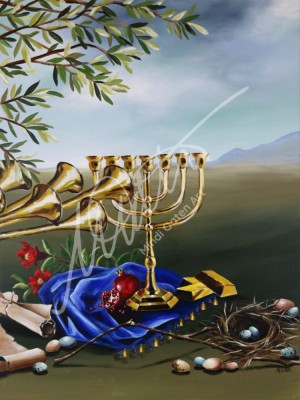
Today we start our study of 2 Chronicles. Originally, Chronicles was written as one book, and it wasn’t until later the book was made into 1 and 2 Chronicles. Our phrase for 1 Chronicles is Son of David because the book constantly points to the coming Messiah, the Son of David. Our phrase for 2 Chronicles is Royal Throne, because it focuses mainly on the kings of Judah, not Israel, who were also tied to David. Mindi’s paintings for 1 and 2 Chronicles is a diptych (two separate paintings that create one picture when placed together), and you’ll see that the trumpets from the first painting carry across to the second.
Chronicles means “the annals or happenings of the days,” and it was written to the Jews after they returned from their captivity in Babylon. At one point, the book was titled, “The Things Omitted,” because it contained so much material not included anywhere else in Scripture. Tradition holds that Ezra was the chronicler (Ezra 7:1–6). The exiles returned to Jerusalem after 70 years in captivity in three phases with: (1) Zerubbabel (Ezra 1—6); (2) Ezra (Ezra 7—10); and (3) Nehemiah (Nehemiah 1—13).
MacArthur explains that the exiles returned to a city in ruins with no Hebrew king, no security, no temple, no dominant region to dwell in, few divine blessings, little of the kingdom’s former wealth, and no presence of God in Jerusalem.1Fifty-five percent of Chronicles is new material.
Second Chronicles 1 records Solomon’s succession to the throne of David. God told Solomon to ask for whatever he wanted, and he requested wisdom. David asked for wisdom too (1 Chronicles 22:12). God granted Solomon’s request with great wealth and wisdom.
Chapters 2—9 cover Solomon’s reign, and chapter 10 records the rebellion of ten tribes in which the kingdom became divided. Chapters 11—36 cover the kings of Judah: Asa’s renovation of the altar (2 Chronicles 15), Jehoshaphat’s establishment of missions (chapter 18); Joash’s repair of the Temple (2 Chronicles 23—24); Hezekiah’s opening of the Temple (chapters 29—31); and Josiah’s discovery of the “book of the law” (2 Chronicles 34—35). In these chapters, renewal, revival, and reformation took place. Captivity is covered in 2 Chronicles 36:15-23. Amidst all this, the Royal Throne is established.
TEACHING
2 Chronicles 2:1-10: Walking out his father David’s desire, Solomon was ready to build the temple for the name of Yahweh (Hebrew name for God meaning the Lord), and a palace for himself (v. 1). He didn’t build a cage for God but rather a temple in God’s name to honor Him. Solomon assigned tasks to men as porters, stonecutters, and supervisors (v. 2). Solomon then asked for help from King Hiram of Tyre, asking for cedars to build the temple to worship Yahweh (vv. 3-4). The temple would be for the one great God who cannot be contained by heaven or earth (vv. 5-6). Solomon requested a craftsman who could engrave and work with yarn to work with the craftsmen from Judah appointed by David (v. 7). King Solomon also asked for logs from Lebanon and promised his craftsmen would help Hiram’s workers to cut and prepare the logs (vv. 8-9). Then he promised to pay the workers with an abundance of food supplies (v. 10).
2 Chronicles 2:11-16: Hiram replied to Solomon’s request by praising the God of Israel who gave King David’s son such wisdom (vv. 11-12). He sent an engraver, Huram-abi, to work with Solomon’s craftsmen on the choice metal and stones for the temple (vv. 13-14). Hiram then asked the king to send the food supplies he had promised, and Hiram’s men would begin to cut the cedar trees down and transport them to the port of Joppa in Israel (vv. 15-16). Solomon was given everything he asked for.
2 Chronicles 2:17-18: Solomon took a census of all the foreigners (non-Israelites) in the land and found 153,600. Then, he put the men to work: 70,000 as porters, 80,000 as stonecutters, and 3,600 as supervisors.
CLOSING
Solomon’s temple was the first of three temples that are discussed in Scripture. Solomon’s temple took seven-and-a-half years to build. However, Solomon’s temple was destroyed in 586 B.C. Zerubbabel rebuilt the second temple, a much more modest temple, upon returning to Jerusalem after the exile. Then King Herod expanded this temple in 20 B.C. that was destroyed by the Romans in A.D. 70. Herod’s temple was the one Jesus visited. There is no physical temple today.
However, Hosea 3:4-5 explains, “The Israelites must live many days without king or prince, without sacrifice or sacred pillar, and without ephod or household idols. Afterward, the people of Israel will return and seek the Lord their God and David their king. They will come with awe to the Lord and to His goodness in the last days.”
Ezekiel 37:27-28 states God will dwell among them and His sanctuary will be with them forever after the reunification of Israel. Jesus talked about a third temple (Matthew 24:15–21). In the last days, we will see the evil one standing in the holy place (2 Thessalonians 2:1-4), so there has to be a temple then.
On the Temple Mount today in Jerusalem are two Muslim holy places. It’s the place where Abraham met Melchizedek (Genesis 14), where Abraham came to sacrifice his son Isaac (Genesis 22), where David bought Ornan’s threshing floor to build an altar to God’s (1 Chronicles 21), and it’s the place where Solomon built the first temple. There’s discussion of where the third temple will be built in the last days. In Revelation 11:1-2, the temple of God is measured.
All this is to say, I believe there will be a physical third temple built in Jerusalem. When it’s completed, we’ll be that much closer to the return of Christ.
John MacArthur, MacArthur’s Bible Commentary: 2 Chronicles (Nashville: Thomas Nelson Publishers, 2005), p. 478.
Questions
-
What was the incredible way for Solomon to begin his reign as king and show he was a godly leader?
-
What was the purpose of going to the tent of meeting? When you go to church, do you sometimes catch yourself desiring to meet more with people or with God?
-
Although Solomon had wealth, health, and fame, why does that not necessarily mean he was satisfied or content (Ecclesiastes 2:1-9, 11)? How does a believer experience joy in the Lord? (Psalm 16:11; John 15:9-11; Philippians 4:4)
-
What were some things King Solomon asked King Hiram for to help build the temple? What was King Hiram’s reaction to the request?
-
How does the concept of a sacred space where God meets with His people point to Jesus, the Holy Spirit, and the Church? (John 1:14; 1 Corinthians 6:19; Ephesians 2:21)
-
What did the Holy Spirit highlight to you in 2 Chronicles 1—2 through the reading or the teaching?

Daily Word
Laura Martin 2 Chronicles 1:10
“Now grant me wisdom and knowledge so that I may lead these people, for who can judge this great people of Yours?”
In preparing the temple, God had to first prepare Solomon. The chronicler describes Solomon as a leader and a king—a man not competent out of his own power but rather a man the Lord highly exalted and was with. When the Lord gave Solomon the opportunity to request one thing, Solomon asked for wisdom. And with wisdom from the Lord, he also received wealth, riches, and glory.
The New Testament describes wisdom from the Lord as pure, peace-loving, gentle, compliant, full of mercy and good fruits, and without favoritism or hypocrisy. As a follower of Christ, Paul wrote you are to pay attention to how you walk, not as unwise but as wise because the days you live in are hard. How will today be different from yesterday if in every situation you pause and ask the Lord for wisdom? You are promised that when you call upon the Lord, He will answer you and tell you great things you do not know. Today, pause in every situation and seek the Lord for wisdom, believe He will hear you, and look for His answer. Fear the Lord because He wants to do great things in your life today!
“Now grant me wisdom and knowledge so that I may lead these people, for who can judge this great people of Yours?”
—2 Chronicles 1:10
FURTHER SCRIPTURE
- Jeremiah 33:3 — “Call to Me and I will answer you and tell you great and unsearchable things you do not know.”
- Ephesians 5:15–16 — “Pay careful attention, then, to how you walk—not as unwise people but as wise—making the most of the time, because the days are evil.”
- James 3:17 — “But the wisdom from above is first pure, then peace-loving, gentle, compliant, full of mercy and good fruits, without favoritism and hypocrisy.”
Lesson and Daily Word
Each day has two parts: the Lesson and the Daily Word. Use these buttons to go from one to the other.
Teaching Notes and Questions
Next to the video, these tabs show the Teaching Notes and the Questions. Your answer to a question saves when you leave the answer box.
The Bible passage
This link opens the passage on Bible Gateway, and that gives the passage its tick. If you read it in your own Bible, tick it by hand in Progress.
Your progress on this lesson
A part ticks itself when you play the video or audio to the end, read the notes or the Daily Word to the end, or answer every question. You can also tick a part by hand here.
Downloads
Here you can save the video, the audio and the lesson as PDF files. Downloads do not count toward your progress.
Need help?
Use this button to send us a question or tell us about a problem. You can also take this tour again from there.