
Struggling to Rely on God
Discover Jesus as: Anointed One 1 Samuel 7-8 Read on Bible Gateway (HCSB)
Lesson
Audio Only
Teaching Notes
INTRO
Chapters 7-8 of 1 Samuel are a crux point, or a transition point, here in the middle of 1 Samuel. Many important things will take place in these two chapters.
TEACHING
1 Samuel 7:1–4: The ark spent 20 years at the house of Abinadab, where his son Eleazar took care of it (vv. 1–2a). Can you imagine the ark of the covenant sitting in your living room? In this one verse, we’ve gone 20 years. Notice there is no mention of the tabernacle or the tent. The whole priesthood was in disarray since the deaths of Eli and his sons. Samuel is not mentioned either. Possibly he traveled for this period of 20 years as a prophet, teaching the people, tribe by tribe, and city by city. He was acknowledged as prophet from Dan (the most northern point in Israel) to Beersheba (the most southern point) (1 Samuel 3:20). “Then the whole house of Israel began to seek the LORD” (v. 2b).
When Time to Revive goes into a city, they look for three things in a community: unity (v. 2b), hunger (v. 2b), and humility (vv. 3–4). The “whole house of Israel” shows the unity. They were seeking the Lord and showing their hunger, a hunger Israel hadn’t experienced for a long time. At Samuel’s instructions, they removed the foreign gods in order to seek the Lord with their full hearts, showing their humility (vv. 3–4). In his instructions, Samuel outlined what was necessary to come before God in holy repentance:
- Their decision must be genuine—they were to “return to God with a whole heart.” Their repentance would be difficult because it would fly in the face of the surrounding culture.
- Their decision must be tangible—they were to “get rid of the foreign gods and the Ashtoreths” that were in their homes and hearts. Ashtoreths were the consort of Ba’al, whose worship included fertility and sexual rites. Since these gods were represented in idol form, their actions must be concrete as they physically removed and destroyed the idols.
- Their decision must be to worship only Yahweh—they could not worship “Yahweh and” but “Yahweh only.”
1 Samuel 7:5–6: The prophet Samuel wanted to address the entire house of Israel in Mizpah (v. 5). Mizpah means “watchtower” or a risen plateau. Scholars are unsure of the exact location of Mizpah. All the people came together without the tabernacle or the ark. There was still some tension between the people in the north and the people in the south. For example, the northern tribes didn’t like the tribe of Judah because they were jealous of their perception that Judah had been treated better than the other tribes. However, Samuel was able to bring all these tribes together despite the tensions. Keep in mind that this north-south divide continued to simmer and ferment for the next 500 years.
In verse 6, Samuel led them to perform a water libation, in which they drew up water and poured it out before the Lord. Bergen suggests this was Israel’s “confession that the Lord’s favor was more important to them than life-sustaining water.”1The people of Israel fasted and confessed their sins to God. “And Samuel judged the Israelites at Mizpah” (v. 6). This was the first time Samuel acted not only as a prophet, but also as a judge. Since Samuel was of the tribe of Levi, he was also a legitimate priest. Samuel became a bridge between the period of the judges and the period of the kings. Samuel was the last of the judges and was sent to all Israel, under the mantle of leadership. Samuel was also a king maker, but in our understanding of the Anointed One, Samuel was actually the royalty anointer. Samuel is a picture of the foreshadowing of the Messiah: priest, prophet, king, and anointer of royalty. Because of their confession and repentance, Samuel prayed. This was a great revival moment that the adversary did not like and he moved against Israel through the Philistines.
1 Samuel 7:7–11: The Philistines heard about the gathering at Mizpah and assumed Israel was getting ready to go to war. They recruited the largest Philistine army ever recorded (v. 7). Picture the entire nation of Israel, including wives and children, watching the huge army of Philistines marching on Mizpah, from a religious convocation on a high plateau. The Israelites had no weapons and were in terror. The Philistines knew the power of the ark from their experiences when they had captured it (1 Samuel 4). When they realized the ark was not with the Israelites, they felt they had an advantage (v. 7).
Something new was happening. Israel had gathered against spiritual warfare, not physical battles, and that was the key! Never was Israel better prepared to receive its enemy. As the lyrics from the Christian rock band, Petra, exclaim: “Get on your knees and fight like a man.” They asked Samuel to intervene for them with God (v. 8). Instead of trying to manipulate God with the ark as they had done in the past, Israel turned to God through intercession. They dared to ask for the seemingly ridiculous, invasive, and intrusive miracle. Samuel offered a burnt offering to the Lord, and the Lord answered him (v. 9). Samuel acted without a word because time was short. He even offered the entire animal as a burnt offering. At that moment of sacrifice, God thundered loudly and overthrew the Philistines (v. 10). The Philistines immediately turned in great disarray and pandemonium. Israel finally understood the God of angel armies was fighting for them, and they chased the Philistine army down below Beth-car (v. 11).
1 Samuel 7:12–18: Since they had been restored to God and then saved by God from the Philistine army, Samuel set up a memorial stone as a reminder of what God had done. He named the place Ebenezer, or stone of hope (v. 12). This is the same name as the site of Israel’s earlier defeat, just at a different location. So the Philistines were subdued and did not invade Israel again (v. 13). Samuel judged Israel for 40 years (vv. 15–17). What about the ark? It is possible Samuel deliberately left the ark in Kiriath-Jearim to teach the Israelites to focus on the substance of faith, rather than the symbol of faith.
1 Samuel 8:1–5: Samuel grew old and appointed two of his sons as judges (v. 1). However, they did not walk in the Lord’s ways (vv. 2-3). The elders of Israel told Samuel his sons could not lead in Samuel’s place when he died. The elders had unity and hunger for an earthly king but not for God. They did not have humility either, as they told Samuel what he was to do (vv. 4-5). Keith Lannon explained chapter 8: “Don’t confuse them with the facts. Here’s an account of when democracy gets it wrong. God helps to make it turn out O.K., even though the people mess it up again later.”2The elders wanted a king so they would be like the earthly rulers, and their argument was that Samuel’s sons were unfit.
1 Samuel 8:6–9: Samuel knew this was an affront to God and to himself. Even though their request was self-centered, Samuel prayed to God. God told him to listen to them because “They have not rejected you; they have rejected Me as their king” (vv. 6–7). This demand of the people had been predicted 300 years earlier by Moses (Deuteronomy 17:14–20), and God promised both Abraham (Genesis 17:7–16) and Jacob (Genesis 35:11) that they would be fathers of kings. God told Samuel to listen to the voice of the people, warn them solemnly, and let them know the actions and deeds of the king (v. 9).
1 Samuel 8:10–18: Samuel repeated God’s words to the people. He did not tell them what a king ought to be, Samuel instead told them what God said the king would be like (vv. 10–18). Everything God said would come true in the rules of kings in both the north and the south of Israel. But the people refused to listen to Samuel (vv. 19–20). God told Samuel to appoint a king (v. 22).
CLOSING
In spite of their rejection, God still had a plan that He would bring to fruition.
Robert Bergen, New American Bible Commentary: 1, 2 Samuel, v. 7 (Nashville: Broadman & Holman Publishers, 1996), p. 107.
Keith Lannon, available online at https://lannononsamuel.wordpress.com/category/1-samuel-8-verses-1-22/.
Questions
-
Why do you think the Israelites left the ark of the Lord at Kiriath-jearim for twenty years? What caused Israel to turn back to the Lord and remove their false gods? (1 Samuel 7:3–4)
-
What does the name Ebenezer mean? Why did Samuel set up a stone and call it this? Where else in Scripture is the Lord referred to as a rock or stone? (Genesis 49:24; Deuteronomy 32:4; 1 Samuel 2:2; Psalm 118:22; Isaiah 44:8; Acts 4:11; 1 Corinthians 10:4; 1 Peter 2:4)
-
What reason or excuse did the Israelites use for requesting a king (1 Samuel 8:4–5)? Did they already have a king (1 Samuel 8:7)? What did the Lord tell Moses in Deuteronomy 17:14–16?
-
The Lord warned the Israelites about the customs or rights of the king they were requesting how? (1 Samuel 8:11–18)
-
What was the Israelites’ response to this warning (1 Samuel 8:19–20)? Who had been fighting their battles (Exodus 14:13– 14; Deuteronomy 1:30; 3:22; Joshua 23:3)? Why do you think they forgot or disregarded this fact? Do you think God’s people today do the same thing?
-
What did the Holy Spirit highlight to you in 1 Samuel 7—8 through the reading or the teaching?

Daily Word
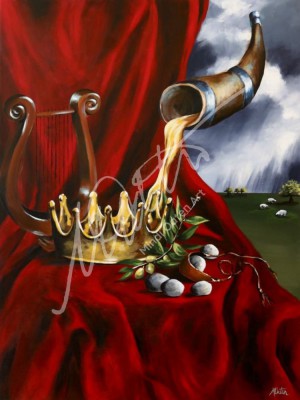
Laura Martin 1 Samuel 8:6–7
“When they said, ‘Give us a king to judge us,’ Samuel considered their demand sinful, so he prayed to the LORD. But the LORD told him, ‘Listen to the people and everything they say to you. They have not rejected you; they have rejected Me as their king.’”
FURTHER SCRIPTURE
- Psalm 81:11–12 — “But My people did not listen to Me; Israel did not obey Me. So I gave them over to their stubborn hearts to follow their own plans.”
- Proverbs 1:29–31— “Because they hated knowledge, didn’t choose to fear the Lord, were not interested in my counsel, and rejected all my correction, they will eat the fruit of their way and be glutted with their own schemes.”
- Romans 8:28 — “We know that all things work together for the good of those who love God: those who are called according to His purpose.”
Lesson and Daily Word
Each day has two parts: the Lesson and the Daily Word. Use these buttons to go from one to the other.
Teaching Notes and Questions
Next to the video, these tabs show the Teaching Notes and the Questions. Your answer to a question saves when you leave the answer box.
The Bible passage
This link opens the passage on Bible Gateway, and that gives the passage its tick. If you read it in your own Bible, tick it by hand in Progress.
Your progress on this lesson
A part ticks itself when you play the video or audio to the end, read the notes or the Daily Word to the end, or answer every question. You can also tick a part by hand here.
Downloads
Here you can save the video, the audio and the lesson as PDF files. Downloads do not count toward your progress.
Need help?
Use this button to send us a question or tell us about a problem. You can also take this tour again from there.