
Hannah's Vow to God
Discover Jesus as: Anointed One 1 Samuel 1-2 Read on Bible Gateway (HCSB)
Lesson
Audio Only
Teaching Notes
INTRO
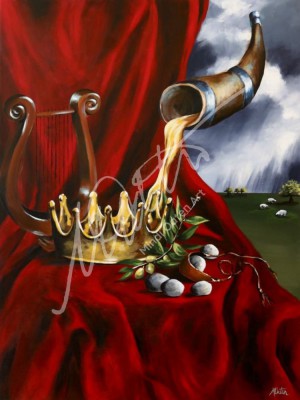
This is the first lesson of 1 Samuel, the fourth book in the historical books of the Old Testament. We’ve already studied Joshua, Judges, Ruth, and now 1 Samuel. In the Old Testament, the book of Samuel is divided into two sections: 1 Samuel and 2 Samuel. In the original manuscript, it was one complete book. There are three major characters in 1 and 2 Samuel: Samuel, Saul, and David who are each the anointed one and point to the Messiah. Our phrase for the book of 1 Samuel is Anointed One.
We like to think the prophet Samuel wrote both books that bear his name. However, Samuel’s death is recorded in 1 Samuel. While it is more accurate to say the writer is unknown, 1 Chronicles 29:29 explains the writers possibly included Nathan and Gad. First Samuel covers a period of 135 years. It’s a book of transition between the chaos of Judges and Ruth where God moves from using priests, to judges, to the time of the prophets, and eventually kings. After this period came the division of Israel into two kingdoms—Israel to the north and Judah to the south. In the first chapters of 1 Samuel, Israel had a corrupt priesthood, a defiled tabernacle, and a stolen ark.1This dire situation will be reversed through His Anointed One.
There are four major themes in 1 and 2 Samuel2:
- The Davidic Covenant(1 Samuel 2:10; 2 Samuel 22:51)—the anointed kings would lead to the anointed Messiah.
- The Sovereignty of God—God was completely in control.
- The Work of the Holy Spirit (1 Samuel 10:10; 16:13)—the Spirit empowered people for divinely appointed tasks.
- The Personal and National Effects of Sin—examples include: Eli and his sons, the lack of reverence for the ark of the covenant, and David’s sin.
TEACHING
1 Samuel 1:1–3: The name Elkanah means “God has created.” Elkanah had two wives—Hannah, who was childless, and Peninnah, who had children (vv. 1–2). Most theologians stress that because Hannah was listed first, she was the first wife. However, because Hannah was childless, Elkanah married a second time. Hannah’s name means “grace,” and we’ll see that it’s an appropriate name because God poured out abundant grace on her. Every year, Elkanah made the journey to the tabernacle in Shiloh to worship the Lord and offer sacrifices (Joshua 18:1). Eli’s sons Hophni and Phinehas served there as priests (v. 3).
1 Samuel 1:4–8: Elkanah gave Peninnah and her children portions of the meat to sacrifice (v. 4), but he gave Hannah a double portion as a sign of how greatly he loved her (v. 5). His action must have caused jealousy in Peninnah, who taunted Hannah every year because the Lord had not allowed her to have children (v. 6). The taunts bothered Hannah greatly, she wept and refused to eat anything (v. 7). Elkanah asked Hannah why she was so troubled, even if she had no children, she had his love (v. 8).
1 Samuel 1:9–28: In the presence of Eli the priest, Hannah prayed to the Lord, weeping as she prayed (vv. 9–10). Hannah asked the Lord to remember her barrenness and begged that He would allow her to have a son. She vowed that her son would spend his life in service to the Lord and promised his hair would never be cut (Nazarite vow) (v. 11). In her prayer, Hannah:
Remembered God’s works(v. 11)—Hannah prayed to God because she remembered who God is and what He had done in the past. She knew the Lord had the power to intervene. She knew of Jericho and Gideon. Because God could do these things in the past, Hannah knew He could take care of her barrenness as well. She addressed Him as “Lord of Hosts” or the Commander of the Lord’s Army (Joshua 5:14).
Poured out her heart to Him (vv. 12–16)—Although Hannah’s lips were moving, she made no sound. Public prayers were made audibly, so Eli wondered if Hannah was drunk (v.13). Eli scolded her, telling her to get rid of the wine (v. 14). Hannah explained that she wasn’t drunk, but had a broken heart and was pouring out her pain to the Lord (v. 15). It’s okay to pour out our pain to God (Psalm 62:8; 142:1–3; Matthew 11:28; Philippians 4:6; 1 Peter 5:7).
Received His peace (vv. 17–18)—Eli told her to go in peace and added his blessing to her request (v. 17). When Hannah left, she no longer looked so despondent (v. 18) (John 14:27; Colossians 3:15).
Trusted His timing (vv. 19–20)—In her peace, Hannah was able to trust God’s timing. “After some time,” or as some translations say, “in due time,” Hannah conceived and gave birth to Samuel whose name means “I requested him from the Lord” (v. 20). When we receive God’s peace, we are able to walk out what He has told us to do.
Worshipped Him in the victory (vv. 21–28)—Elkanah took his family to Shiloh to worship the Lord for the gift of Samuel. Hannah and the child stayed behind because the child was not yet weened and the time had not come to return him to the Lord. Once Samuel was weaned, Hannah took him to Shiloh along with the required sacrifices: a three-year-old bull, a half bushel of flour, and a jar of wine (Numbers 15:8–10). Hannah’s sacrifices were above what was required (Psalm 95:2–3; 100:4–5).
CLOSING
When we trust in God’s timing, we are able to worship the Lord in His victory. All of this leads to Hannah’s prayer of thanksgiving and worship in 1 Samuel 2:1–10. Chapter 2 of 1 Samuel records how Samuel grew up under Eli’s care and that Eli’s sons were wicked men. As God began removing the corrupt priesthood, He was raising up a young boy named Samuel.
Earl Radmacher, Ronald B. Allen, and H. Wayne House, eds., Nelson’s New Illustrated Bible Commentary (Nashville: Thomas Nelson Publishers, 1999), p. 343.
John MacArthur, The MacArthur Bible Commentary (Nashville: Thomas Nelson Publishers, 2005), pp. 300–301.
Questions
-
In 1 Samuel 1:1–8, there are two wives, including one who had no children. Where else in the Old Testament do we see the same scenario? (Genesis 29)
-
Why did Eli, the priest, think that Hannah was drunk? (1 Samuel 1:13–14)
-
In 1 Samuel 1:18, Hannah left no longer sad and she ate food. What do you think happened to change her? Have you prayed and known beyond a doubt that God heard you and granted your prayers? In what ways?
-
What vow did Hannah make to the Lord in 1 Samuel 1:11? Did she keep her vow (1 Samuel 1:24)? What did keepingthat vow mean for her as a parent? (1 Samuel2:11)
-
In 1 Samuel 2:20–21, Eli prayed for Hannah each year. What was his prayer? Did God grant it?
-
Eli, the priest, had two sons who served in the Temple and sinned greatly against God. In 1 Samuel 2:27, God sent a man to give Eli a message. What was the message? What was to become of him and his sons?
-
What did the Holy Spirit highlight to you in 1 Samuel 1—2 through the reading or the teaching?

Daily Word
Laura Martin 1 Samuel 1:15–16
“‘No, my lord,’ Hannah replied. ‘I am a woman with a broken heart. I haven’t had any wine or beer; I’ve been pouring out my heart before the LORD. Don’t think of me as a wicked woman; I’ve been praying from the depth of my anguish and resentment.’”
FURTHER SCRIPTURE
- Psalm 62:8 — “Trust in Him at all times, you people; pour out your hearts before Him. God is our refuge. Selah”
- John 14:27 — “Peace I leave with you. My peace I give to you. I do not give to you as the world gives. Your heart must not be troubled or fearful.”
- Philippians 4:6 — “Don’t worry about anything, but in everything, through prayer and petition with thanksgiving, let your requests be made known to God.”
Lesson and Daily Word
Each day has two parts: the Lesson and the Daily Word. Use these buttons to go from one to the other.
Teaching Notes and Questions
Next to the video, these tabs show the Teaching Notes and the Questions. Your answer to a question saves when you leave the answer box.
The Bible passage
This link opens the passage on Bible Gateway, and that gives the passage its tick. If you read it in your own Bible, tick it by hand in Progress.
Your progress on this lesson
A part ticks itself when you play the video or audio to the end, read the notes or the Daily Word to the end, or answer every question. You can also tick a part by hand here.
Downloads
Here you can save the video, the audio and the lesson as PDF files. Downloads do not count toward your progress.
Need help?
Use this button to send us a question or tell us about a problem. You can also take this tour again from there.