
Solomon's Anointed Reign
Discover Jesus as: Something Greater 1 Kings 1 Read on Bible Gateway (HCSB)
Lesson
Audio Only
Teaching Notes
INTRO
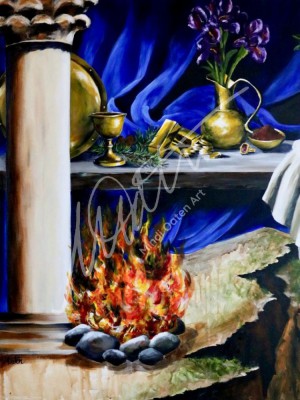
We’re still in study of the 12 historical books. So far, we’ve covered five. Just like 1 and 2 Samuel, Mindi has combined two paintings for these two books into one complete image (called a diptych). Our phrase for 1 Kings is Something Greater. We’ll be comparing Solomon’s life to Jesus’ to see how Christ is greater than Solomon. At the end of 2 Samuel, David was preparing Solomon to inherit his throne. First Kings shows this time of major leadership transition. The Davidic Covenant from 2 Samuel 7 was now being passed on to Solomon.
Originally, 1 and 2 Kings was one book. Before that, these books were the third and the fourth parts of the book of Samuel. The book was written between 561–538 B.C. The historical information in the book was from the book of the acts of Solomon, the Chronicles of the kings of Israel (1 Kings 14:19), and the Chronicles of the kings of Judah (1 Kings 14:29). There are also references in Isaiah and Jeremiah to 1 Kings. MacArthur proposes that a single, inspired author, living in Babylon during the exile, used these pre-exilic source materials.”1
First Kings 1-11 covers Solomon’s reign and the uniting of Israel and Judah. In 1 Kings 12, this united kingdom began to struggle and there was division in the northern and southern kingdoms. In 2 Kings, the history of Judah, the southern kingdom, is outlined. MacArthur explains that “the Book of Kings is not only accurate history, but interpreted history. The author . . .wished to communicate the lessons of Israel’s history to the exiles . . . why the Lord’s judgment of exile had come.”2Bottom line: The writer wanted to make sure the exiles understood that since the Mosaic Law required that Israel be obedient to God, disobedience led to punishment and being exiled.3The common theme that runs through 1 Kings is about the kings of both Israel and Judah, they “did evil in the sight of the Lord.” Therefore, God sent His prophets to confront the kings to turn their nations back to God. When they rejected God’s prophets and their warnings, prophets declared both kingdoms would be exiled.
Geographically, Israel would have included all the land from Dan in the north to Beersheba in the south. The pattern at the beginning of the book is one new king after another was introduced with information about each, the date of succession in comparison to the contemporary ruler in the other kingdom, the age of the king when he took the throne, and the length and the place of his reign. In the Judah line of kings, the mother’s name was given. Other information given was a spiritual appraisal of each king’s reign (whether he did evil or good). Finally, at the end of the king's reign, citation of historical documents that verified the information was given, as well as notice or death and burial, and the identification of the successor.4
MacArthur presents three theological themes for 1 Kings: (1) “the Lord judged Israel and Judah because of their disobedience to His Law,” (2) “the word of the true prophets came to pass,” and (3) “the Lord remembered His promise to David.”5With this background, let us dig into 1 Kings 1.
TEACHING
1 Kings 1:1–10: David was around 70 years old when he became ill and he could not get warm. (v. 1). His servants suggested that a virgin be found who could attend to David as his caregiver (v. 2). Early church historian Josephus noted that “using a healthy person’s body warmth to care for a sick person” was a medical treatment referenced in the second century.6The servants found Abishag the Shunammite, a beautiful girl to attend David. No intimate relations took place (v. 4). David’s fourth-born son Adonijah, his oldest surviving son, claimed he would be king. He had chariots, cavalry, and men run ahead of him (v. 5). Adonijah exalted himself (Luke 14:11). David showed his passivity and never reprimanded Adonijah for his actions (v. 6). Adonijah conspired with David’s army commander, his nephew Joab, and Abiathar. They agreed to support his claim to the throne (v. 7). However, Zadok the priest, Nathan the prophet, and David’s other warriors did not support Adonijah (v. 8). Note: Shimei mentioned in verse 8 was not the man who hurled curses and threw stones at David (1 Kings 2:8-9; 2 Kings 4:7,18). Adonijah sacrificed animals and invited his royal brothers, the men of Judah, and the servants of Solomon to come. He did not invite those who had not sided with him (vv. 9-10). He was working to take the throne from Solomon.
1 Kings 1:11-31: Nathan told Bathsheba about what was happening and she went to King David asking about Solomon’s inheritance to be king, and explained how Adonijah was trying to take the inheritance from Solomon. She asked David to tell Israel who was to sit on the throne after him (vv. 11-20). Then, Nathan came into David and confirmed what Bathsheba had told him and explained that Adonijah was working behind David’s back and not including him or the prophet (vv. 21-27). David called Bathsheba before him and swore again that Solomon was his rightful heir (vv. 28-31).
1 Kings 1:32-40: David called for Zadock the priest, Nathan the prophet, and Benaiah. When they came before him, he instructed them to place Solomon on David’s mule and take him to Gihon to anoint Solomon as king over Israel (vv. 32-37). Solomon riding on David’s mule would show Israel that David was passing his throne to Solomon (Zechariah 9:9). The men did as David had instructed, they took Solomon on David’s mule to Gihon and anointed him with oil from the tabernacle. They blew the ram’s horn and the people declared Solomon as their king (John 12:13). Then, they followed him with “such a great joy that the earth split open from the sound” (vv. 38-40).
1 Kings 1:41-53: Adonijah received word of what had happened (vv. 41-48). Adonijah and his guests trembled in fear from the news (v. 49). Adonijah was so afraid of Solomon that he took hold of the horns of the altar (v. 50). His action meant he was asking for mercy and refuge from those who would commit unintentional crimes (Leviticus 4; Exodus 21:12-14). Solomon received word that Adonijah was holding onto the horns of the altar, asking for Solomon to swear that he would not kill him (v. 51). Solomon agreed as long as no evil was found in Adonijah (v. 52). Solomon had Adonijah brought before him. Adonijah paid homage to King Solomon and sent Adonijah home, basically with a pardon (v. 53).
CLOSING
What we’re going to see in 1 Kings, especially in the first eleven chapters, is that even though Solomon was an amazing man of God, Jesus is greater (Matthew 12:42).
John MacArthur, The MacArthur Bible Commentary (Nashville: Thomas Nelson Publishers, 2005), p. 387.
MacArthur, p. 388.
MacArthur, p. 388.
MacArthur, p. 389.
MacArthur, p. 389.
Earl Radmacher, Ronald B. Allen, and H. Wayne House, eds., Nelson’s New Illustrated Bible Commentary: 2 Samuel (Nashville: Thomas Nelson Publishers, 1999), p. 428.
Questions
-
Why did Adonijah take it upon himself to seek the throne? (2 Samuel 15:1-12; I Kings 1:6) Does this show that the ‘sins of the fathers’ passed on to him? (Exodus 20:5; Deuteronomy 5:9)
-
Why do you think that David chose Solomon, over his other sons, to be his successor to the throne?
-
In verse 13, what could be the reason that Nathan told Bathsheba to go into David before him instead of just telling him about Adonijah’s plan himself?
-
In verse 50, Adonijah “took hold of the horns of the altar.” Why do you think he did this? Was there another time in the Bible that this was mentioned? (Exodus 21:14; 1 Kings 2:28-29)
-
What did the Holy Spirit highlight to you in 1 Kings 1 through the reading or the teaching?

Daily Word
Laura Martin 1 Kings 1:29-30
“The king swore an oath and said, ‘As the Lord lives, who has redeemed my life from every difficulty, just as I swore to you by the Lord God of Israel: Your son Solomon is to become king after me, and he is the one who is to sit on my throne in my place, that is exactly what I will do this very day.’”
King David was confined to his room due to old age. It was here the prophet Nathan and Bathsheba visited him to share the news about Adonijah, David’s son, who was exalting himself as David’s successor and conspiring and gathering people to support him as king. Without hesitating, King David swore an oath that it was Solomon who would become king after him. He ordered Nathan and Zadok the priest to anoint Solomon. The people celebrated Solomon, their new king, as he rode through town on David’s mule. That is, everyone celebrated but Adonijah, who now feared for his own life. However, Solomon granted mercy and forgiveness towards Adonijah for the prideful actions taken against him. The Lord’s hand was upon Solomon.
In many ways, Solomon can be compared to Jesus. Solomon was celebrated while riding on a mule, was anointed as king, had great wisdom, and showed mercy and forgiveness. Even so, Jesus is greater than Solomon. Jesus came riding on a donkey as the people shouted, “Hosanna.” Jesus, the Anointed One, forgives all your sins, offering grace, mercy, and eternal life. Jesus is the King of kings and the Lord of lords. Today, worship the Lord. Bow down before Him. Step away from the things of this world and pour your heart out to the one who saved you from death. He is worthy of your praise. He is the Almighty One!
“The king swore an oath and said, ‘As the Lord lives, who has redeemed my life from every difficulty, just as I swore to you by the Lord God of Israel: Your son Solomon is to become king after me, and he is the one who is to sit on my throne in my place, that is exactly what I will do this very day.’”
—1 Kings 1:29-30
FURTHER SCRIPTURE
- Matthew 12:42 — “The queen of the south will rise up at the judgment with this generation and condemn it, because she came from the ends of the earth to hear the wisdom of Solomon; and look—something greater than Solomon is here!”
- John 14:12 — “I assure you: The one who believes in Me will also do the works that I do. And he will do even greater works than these, because I am going to the Father.”
- 1 Timothy 6:15-16 — “God will bring this about in His own time. He is the blessed and only Sovereign, the King of kings, and the Lord of lords, the only One who has immortality, dwelling in unapproachable light; no one has seen or can see Him, to Him be honor and eternal might. Amen”
Lesson and Daily Word
Each day has two parts: the Lesson and the Daily Word. Use these buttons to go from one to the other.
Teaching Notes and Questions
Next to the video, these tabs show the Teaching Notes and the Questions. Your answer to a question saves when you leave the answer box.
The Bible passage
This link opens the passage on Bible Gateway, and that gives the passage its tick. If you read it in your own Bible, tick it by hand in Progress.
Your progress on this lesson
A part ticks itself when you play the video or audio to the end, read the notes or the Daily Word to the end, or answer every question. You can also tick a part by hand here.
Downloads
Here you can save the video, the audio and the lesson as PDF files. Downloads do not count toward your progress.
Need help?
Use this button to send us a question or tell us about a problem. You can also take this tour again from there.