
Back To Basics
Discover Jesus as: Perfect Love 1 John 1 Read on Bible Gateway (HCSB)
Lesson
Audio Only
Teaching Notes
INTRO
We are now going to study 1 John, which is considered another general letter in the New Testament, and our fiftieth book of the Bible. Revive School is almost done. First John is the first and largest in the series of three epistles that bear the apostle John’s name. McArthur explains, “Since the letter identifies no specific church, location, or individual to whom it was sent, its classification is a ‘general epistle.’ The epistle does not identify the author, but the strong, consistent, and earliest testimony of church ascribes it to John the disciple and apostle (Luke 6:13-14).”1
There is an intriguing argument that John was so well known in the early church that his name didn’t need to be listed on the letter. MacArthur wrote, “For only someone of John’s well-known and preeminent status as apostle would be able to write with unmistakable authority, expecting complete obedience from his readers, without clearly identifying himself.”2
Background: James, Jesus’ disciple, was John’s brother. Jesus referred to these brothers as the sons of Zebedee (Matthew 10:2) and nicknamed them “Sons of Thunder” (Mark 3:17). John was one of the three most intimate associates of Jesus, along with Peter and James (Matthew 17:1; 26:37). John was an eyewitness or participant in Jesus’ earthly ministry (1 John 1:1-4). In addition to these three epistles, John also wrote the Gospel of John and the book of Revelation. John always referred to himself as “the disciple Jesus loved.”3
There are no historical indicators to date when 1 John was written. It was most likely written in the latter part of the first century. MacArthur states, “Church tradition consistently identifies John, in his advanced age, as living and actively writing during his time at Ephesus in Asia Minor.”4 Most scholars believe that John wrote his gospel first, followed shortly thereafter by the three letters in the New Testament, and then Revelation a few years later.5
Even though he was older, John remained active in ministry while he wrote his letters. At the writing of this letter, John lived in Ephesus where he served many of the churches that had been started in the area. Ephesus had become an intellectual center at the time of John’s writings.6
One of the new ideas that had arisen was known as Gnosticism. MacArthur notes that Gnostics “asserted that matter was inherently evil and spirit was good.”7 Because of this, Gnostics denied Christ’s humanity. Gnostics also elevated human authority over divine revelation, meaning Scripture was not authoritative. Instead, human perception was the authority. Gnostics generally fell into one of two camps. In the first camp, some Gnostics asserted Jesus’ body was not real but only appeared to be real. This is why John used words like “seen,” “heard” and “touched with our hands” (v. 1) at the very beginning of this letter. In the second camp, other Gnostics believed the spirit of Jesus descended into the man Jesus at His baptism and then departed at His crucifixion. In response, John wrote: “Jesus Christ—He is the One who came by water and blood, not by water only, but by water and blood. And the Spirit is the One who testifies, because the Spirit is the truth” (1 John 5:6). As a result of denying Jesus’ humanity, Gnosticism denied the atonement of Jesus’ death, because Jesus had to be fully human in order to pay the price for humanity’s sin.8
In response to the challenges of the Gnostics, MacArthur observes, “The overall theme of 1 John is ‘back to the basics of Christianity.’”9 Proper belief in Christ produces obedience. Obedience leads to loving others. Love then produces joy. MacArthur explains, “The constant repetition of three sub-themes reinforces the overall theme regarding faithfulness to the basics of Christianity: (1) happiness (1 John 1:4), (2) holiness (1 John 2:1), and (3) assurance (1 John 5:13). By faithfulness to the basics, his readers will experience these three results continually in their lives.”10
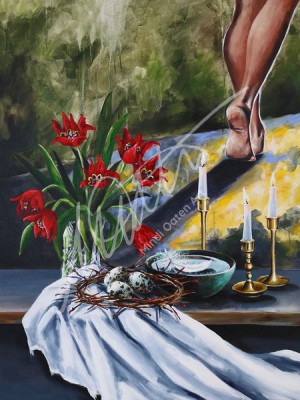
Mindi’s painting for 1 John depicts seven flowers called sun’s eye tulips, the native flower of Israel, which represent the love of Christ and His blood shed for us. Seven represents a complete and perfect picture since the theme of 1 John is complete and perfect love. Our phrase for 1 John is Perfect Love: “There is no fear in love; instead, perfect love drives out fear, because fear involves punishment. So, the one who fears has not reached perfection in love” (1 John 4:18).
TEACHING
1 John 1:1-4: Nelson’s Commentary notes that the phrase, “what was,” could imply one of four things:
- The revelation about Christ
- The teachings of Christ
- The eternal life manifested through Christ
- Christ Himself.11
In the first four verses, John emphasizes he was an eyewitness to the ministry of Jesus. Wiersbe emphasizes John experienced life with Jesus but also shared his life with Jesus.12 Faith and life shared together would produce joy (v. 4).
1 John 1:5–10: By emphasizing, “God is light and there is absolutely no darkness in Him” (v. 5), John argued that there is absolutely no sin in the person of God, neither in the Father nor the Son. Those who claimed to know Jesus but who “walk in darkness” (v. 6) were lying. In Revelation, John wrote: “But the cowards, unbelievers, vile, murderers, sexually immoral, sorcerers, idolaters, and all liars—their share will be in the lake that burns with fire and sulfur, which is the second death” (Revelation 21:8). If we say we know Jesus but our lives are characterized by darkness, we are lying, and God will ultimately judge us unless we truly turn to Christ.
The phrase, “If we,” is repeated five times in verses 6-10. In verses 6, 8, and 10, it is in reference to people who do not truly have a relationship with Jesus. In verses 7 and 9, it is in reference to true believers in Christ. Walking in the light and fellowshipping with other believers demonstrates true faith in Jesus that cleanses sin (v. 7). A failure to acknowledge personal sin demonstrates a lack of faith in Jesus (v. 8). Jesus will forgive us of our sins when we confess them (v. 9). Failing to acknowledge our sin makes us liars and demonstrates that “His word is not in us” (v. 10).
CLOSING
There are two groups of people. The first group maintains their own sinlessness. They are in conflict with God’s Word and demonstrate themselves to be lying. The second group knows that Jesus cleanses us from sin in an ongoing fashion as we walk in the light and pursue freedom in Him. Continue to ask the Lord to set you free.
John MacArthur, The MacArthur Bible Commentary (Nashville: Thomas Nelson Publishers, 2005), pp. 1944.
MacArthur, p. 1944.
MacArthur, p. 1944.
MacArthur, p. 1944.
MacArthur, p. 1944.
MacArthur, p. 1945.
MacArthur, p. 1945.
MacArthur, p. 1945-1946
MacArthur, p. 1946.
MacArthur, p. 1946.
Earl Radmacher, et. al., Nelson’s New Illustrated Bible Commentary (Nashville: Thomas Nelson, 1999), p. 1704.
Warren Wiersbe, The Wiersbe Bible Commentary: New Testament (Colorado Springs: David C Cook, 2007), p. 961–962.
Questions
-
What could John have been referring to when he mentioned “from the beginning” in 1 John 1:1? (John 1:1; 1 John 2:7, 24)
-
How has God revealed or manifested Himself to us? (John 1:1, 14:9; Romans 1:20; Colossians 1:15; Hebrews 1:1-3; 1 John 1:1-2)
-
What should the belief in Christ and the love of Christ produce in you? (1 John 1:4; 2:1; 5:13)
-
What are three things John said would make you a liar? (1 John 1:6-10)
-
What did the Holy Spirit highlight to you in 1 John 1 through the reading or the teaching?
Daily Word
Laura Martin 1 John 1:5
“Now this is the message we have heard from Him and declare to you: God is light, and there is absolutely no darkness in Him.”
FURTHER SCRIPTURE
- Psalm 27:1 — “The Lord is my light and my salvation—whom should I fear? The Lord is the stronghold of my life— of whom should I be afraid?”
- John 8:12 — “Then Jesus spoke to them again: ‘I am the light of the world. Anyone who follows Me will never walk in the darkness but will have the light of life.’”
- 1 John 1:6–9 — “If we say, ‘We have fellowship with Him,’ yet we walk in darkness, we are lying and are not practicing the truth. But if we walk in the light as He Himself is in the light, we have fellowship with one another, and the blood of Jesus His Son cleanses us from all sin. If we confess our sins, He is faithful and righteous to forgive us our sins and to cleanse us from all unrighteousness.”
Lesson and Daily Word
Each day has two parts: the Lesson and the Daily Word. Use these buttons to go from one to the other.
Teaching Notes and Questions
Next to the video, these tabs show the Teaching Notes and the Questions. Your answer to a question saves when you leave the answer box.
The Bible passage
This link opens the passage on Bible Gateway, and that gives the passage its tick. If you read it in your own Bible, tick it by hand in Progress.
Your progress on this lesson
A part ticks itself when you play the video or audio to the end, read the notes or the Daily Word to the end, or answer every question. You can also tick a part by hand here.
Downloads
Here you can save the video, the audio and the lesson as PDF files. Downloads do not count toward your progress.
Need help?
Use this button to send us a question or tell us about a problem. You can also take this tour again from there.