
The Power of a Plan
Discover Jesus as: Son of David 1 Chronicles 23-24 Read on Bible Gateway (HCSB)
Lesson
Audio Only
Teaching Notes
INTRO
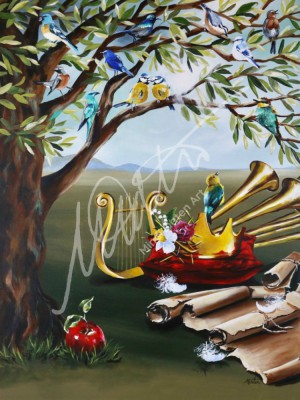
I would strongly suggest looking at Mindi’s painting for this chapter. It is one of my favorites. There are many different aspects to this painting. It is a picture of an olive tree. At the base, she’s used the roots to represent growing sin. Mindi has also used 12 branches that represent the 12 tribes, seven trumpets that represent the priesthood, the harp that represents David’s lifestyle of worship, a bird singing to the Lord, the crown of glory, and the scrolls at the bottom that represent the blueprints of the plans for God’s people. Today I want to focus on the tribe of Levi.
TEACHING
1 Chronicles 23:1: The phrase “old and full of day” describes David as a righteous man. The only other people described that way were Abraham, Isaac, Job, and Moses. Solomon was anointed as king before David passed away. First Kings 3:13-14 contains the promise that was passed down from David to King Solomon. This was the inheritance; this was the blessing. This was the result of King David’s righteousness (Deuteronomy 5:33) and an example of a long life well lived.
1 Chronicles 23:2: The leaders of Israel were David’s sons, the princes of Israel. First Chronicles 3:1-9 shows David’s lineage. David called his sons together, who were still living, to talk about his last days.
1 Chronicles 23:3-4: At this point, the Levitical men totaled 38,000. Why did they count the men who were 30 years or older (Numbers 4:3)? On a practical level, these men were seasoned and mature. Of the 38,000 men, 24,000 were given the task of building the temple, another 6,000 were chosen to be officers and judges.
1 Chronicles 23:5: Also, 4,000 men were chosen to be gatekeepers and 4,000 were chosen to be instrumentalists. King David was a cool inventor. He made many musical instruments like the lyre. What is so cool is that you can see a parallel between the Old and New Testaments in Ephesians 4:11 (1 Corinthians 12:27-31). It is not about being a popular apostle or pastor; it is about being the body of Christ!
As I look at this chapter, what I see coming into play is that they needed 24,000 builders. They needed instrumentalists and judges. Everyone was needed. We are all equal in the body of Christ. Yes, there is an authority structure, but we are all equal. What King David was doing was unfolding the power of the plan—laying out the blueprint. His plan determined who was going to do which tasks and assignments. Because of the confusion in the land at the time, David called his sons to make sure they completely understood their roles.
1 Chronicles 23:6: David divided the 38,000 men into divisions according to Levi’s sons. David’s logic in dividing the men, according to which son of Levi they descended from, was because he understood that the family ties were strong.
1 Chronicles 23:7-12: As David set up the plan, he worked through family by family, level by level, and name by name.
1 Chronicles 23:13: This was evidence of the everlasting consecration of Moses and Aaron (1 Peter 2:4-10). What Moses had sown years ago was coming to fruition in 1 Peter. What you sow is what you are going to reap. What you do now will affect future generations. In this idea of the royal priesthood, Tersteegen wrote,
“The race of God’s anointed priest
Shall never pass away
Before his glorious face they stand,
And serve him night and day.
Though reason raves, and unbelief
Flows on, a mighty hood,
There are and shall be till the end,
The hidden priest of God.
His chosen souls, their earthly dross Consumed in sacred fire,
To God’s own heart their hearts ascend
In flame of deep desire;
The incense of their worship fills
His Temple’s holiest place;
Their song with wonder fills the Heavens,
The glad new song of grace.1
We get to participate in the royal priesthood. As Peter said, we are the living stones being formed together—we are the body of Christ. We are the blueprint. We are a part of the plan, the living stones of the Holy Spirit.
1 Chronicles 23:25-26: Remember the book of Judges was a little crazy! Israel was enjoying a level of peace against their previous adversaries. The ark of the covenant would now be safely kept in a new palatial structure. David’s tabernacle would be a permanent structure, the center of worship for all Israel and beyond. What made this a holy place wasn’t the gold or the precious stones. What made this place holy was that this was where the Holy One was.
1 Chronicles 23:27: Unfortunately, holy places do not always stay holy. When we start to worship structures and buildings more than God, He removes His presence. God’s presence did not reside in this new temple forever. The temple spoken of here is no longer in Jerusalem, and this is what happens when we kick God out of the building.
CLOSING
David, under the anointing of God Himself, set the stage for what would be built. He committed the plan to the Lord. We’ll see in the coming chapters how this plan plays out. Spoiler alert: It succeeds! This planning phase spills over into chapter 24. Layer upon layer, brick by brick, King David was building his lifelong dream—to build for the Lord a house worthy of Him. David was putting his affairs in order so that the transition to Solomon’s reign was seamless and efficient. The blueprint was in place and we begin to see the power of this plan.
Gerhard Tersteegen (1697–1769); quoted in A. W. Tozer, The Christian Book of Mystical Verse (Chicago: Moody Publishing, 2016) pp. 78–79.
Questions
-
In 1 Chronicles 23:3, why was the census taken only on the Levites who were 30 years of age or older? (Numbers 4:1–4)
-
The Levites were ordered by God to take care of the temple. Where do you think David got the idea to put specific families in charge of specific duties? Do you think this was inspired?
-
In 1 Chronicles 24:2, Nadab and Abihu died before their father. How did they die and why? (Leviticus 10:1–2)
-
What did the Holy Spirit highlight to you in 1 Chronicles 23—24 through the reading or the teaching?

Daily Word
Laura Martin 1 Chronicles 23:30
“They are also to stand every morning to give thanks and praise to the LORD, and likewise in the evening.”
FURTHER SCRIPTURE
- Psalm 9:1 — “I will thank Yahweh with all my heart; I will declare all Your wonderful works.”
- Psalm 95:2–3 — “Let us enter His presence with thanksgiving; let us shout triumphantly to Him in song. For the Lord is a great God, a great King above all gods.”
- Matthew 28:20b — “And remember, I am with you always, to the end of the age.”
Lesson and Daily Word
Each day has two parts: the Lesson and the Daily Word. Use these buttons to go from one to the other.
Teaching Notes and Questions
Next to the video, these tabs show the Teaching Notes and the Questions. Your answer to a question saves when you leave the answer box.
The Bible passage
This link opens the passage on Bible Gateway, and that gives the passage its tick. If you read it in your own Bible, tick it by hand in Progress.
Your progress on this lesson
A part ticks itself when you play the video or audio to the end, read the notes or the Daily Word to the end, or answer every question. You can also tick a part by hand here.
Downloads
Here you can save the video, the audio and the lesson as PDF files. Downloads do not count toward your progress.
Need help?
Use this button to send us a question or tell us about a problem. You can also take this tour again from there.